
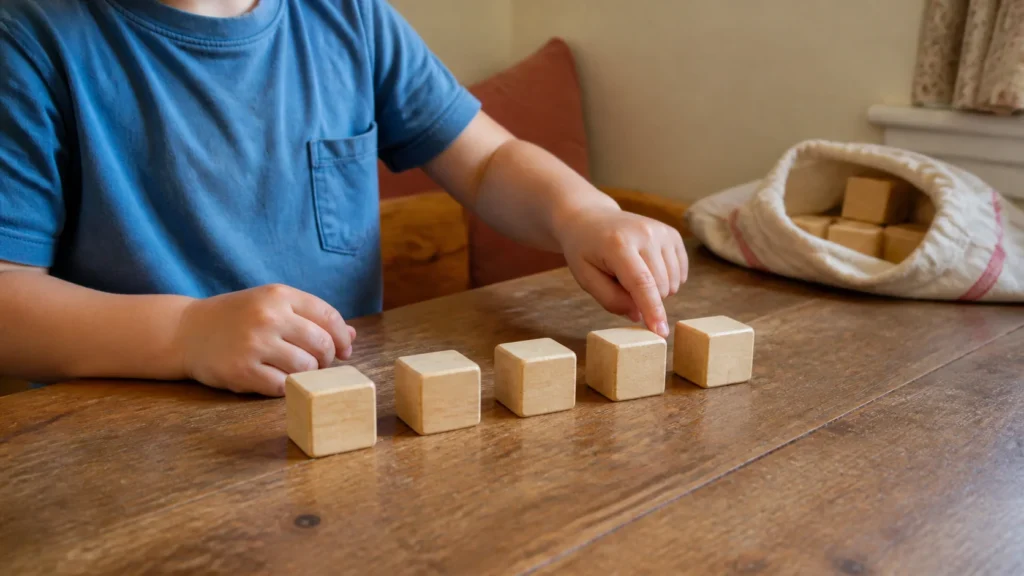
Children often begin addition by counting every finger or object from one. This is an important starting point, but it can become slow as the numbers grow.
Learning doubles and near doubles gives children a faster strategy. When a child knows that 4 + 4 = 8, the nearby fact 4 + 5 becomes easier: double 4 is 8, then add one more to make 9.
These free doubles and near doubles worksheets are Stage 7 of our Kindergarten Mind Computation Using Fingers program. The printable pack helps children recognize equal finger groups, remember common doubles, and use a known double to solve a fact whose addends are one apart.
Download the Stage 7 Worksheets
Download the Stage 7 Doubles and Near Doubles Worksheets (PDF)
The printable PDF contains six A4 activity pages. Each page includes a name line and is suitable for home, classroom, tutoring, or homeschool practice.
What Are Doubles Facts?
A doubles fact adds a number to itself.
Examples include:
- 1 + 1 = 2
- 2 + 2 = 4
- 3 + 3 = 6
- 4 + 4 = 8
- 5 + 5 = 10
- 6 + 6 = 12
The two addends are equal. Children can model the fact by showing the same number of fingers in two groups.
For example, show four fingers on one hand pattern and another four fingers on a second hand pattern. The two groups match, so the child can think, “Double 4 is 8.”
Recognizing the pattern is more useful than repeatedly counting all eight fingers. With practice, the child begins to remember the total automatically.
What Are Near Doubles?
A near double is an addition fact in which the two addends are one number apart.
Examples include:
- 2 + 3
- 3 + 4
- 4 + 5
- 5 + 6
- 6 + 7
The child uses the smaller number to make a doubles helper fact, then adds one.
For 5 + 6:
- Think of the known double: 5 + 5 = 10.
- Notice that 6 is one more than 5.
- Add one more: 10 + 1 = 11.
- Therefore, 5 + 6 = 11.
This strategy helps children move away from counting every object and toward flexible mental computation.
Why Teach Doubles Before Near Doubles?
Children need a familiar fact before they can use it as a helper. Doubles are useful because the two groups are equal, easy to model, and often easier to remember.
Once doubles facts are familiar, near doubles require only one additional step.
Instead of counting 4 + 5 from the beginning, a child can think:
Double 4 is 8. One more is 9.
The strategy reduces the amount of counting a child must hold in working memory. It also teaches that addition facts are connected rather than separate facts that must all be memorized individually.
How Fingers Support the Strategy
Fingers provide a concrete model that children always have available. They allow a learner to see equal groups before trying to picture those groups mentally.
When teaching 3 + 3:
- Show three fingers in the first group.
- Show three fingers in the second group.
- Ask whether the groups are the same.
- Count or recognize the total of six.
- Say, “Double 3 is 6.”
Next, change the second group to four fingers:
- Keep the first group at three.
- Add one finger to the second group.
- Recall that 3 + 3 = 6.
- Add the extra finger.
- Say, “3 + 4 is 7.”
The extra finger makes the relationship between the double and near double visible.
What Is Included in the Printable Pack?
The Stage 7 PDF contains six progressive worksheet pages.
Page 1: Double Finger Facts
Children count two matching finger patterns and solve doubles from 1 + 1 through 5 + 5.
This page introduces the main idea: a double contains two equal groups.
Page 2: Near Double – One More
Children solve near doubles such as 2 + 3 and 6 + 7. Each problem includes space to complete the related doubles helper fact.
For example:
- Problem: 4 + 5
- Helper: 4 + 4 = 8
- Add one: 8 + 1 = 9
Page 3: Near Double Number Line
The number-line page shows how the “one more” step changes the total.
Children begin at the doubles total and make one additional hop. This connects the finger strategy to a visual number-line model.
Page 4: Doubles Story Problems
Three short addition stories use apples, balloons, and blocks. Children can count the pictures, use their fingers, or apply a doubles helper fact.
Each problem includes space for a number sentence and final answer.
Page 5: Circle the Correct Answer
Children solve a mixture of doubles and near doubles, then circle the correct answer from four choices.
This activity checks whether the child can choose the total without relying on an already completed equation.
Page 6: Fill in the Missing Number
The final page asks children to complete equations such as:
- 3 + __ = 6
- 4 + __ = 9
- __ + 5 = 10
- 6 + __ = 13
- __ + 7 = 14
Missing-number problems encourage children to think about the relationship between the addends and total.
Learning Objectives
After completing the Stage 7 worksheets, children should have opportunities to:
- recognize doubles as two equal groups;
- recall common doubles facts;
- identify addends that are one apart;
- use a doubles fact to solve a near double;
- explain that a near double is one more than the related double;
- use fingers and number lines as visual models;
- solve addition facts within and slightly beyond 10; and
- build speed and confidence with mental addition.
Mastery may require repeated practice. A child does not need to complete all six pages in one sitting.
How to Teach Doubles Step by Step
Step 1: Build Equal Groups
Use fingers, blocks, counters, buttons, or another safe manipulative. Create two groups containing the same number.
Ask:
- Are the groups equal?
- How many are in each group?
- How many are there altogether?
Step 2: Say the Fact in a Consistent Way
Use a short phrase such as, “Double 4 is 8.” Repeating the same language helps children connect the word double with two equal groups.
Step 3: Practice in a Predictable Order
Begin with:
- double 1;
- double 2;
- double 3;
- double 4; and
- double 5.
When those facts are becoming familiar, continue with double 6, double 7, and double 8.
Step 4: Add One to Make a Near Double
Show two equal groups, then place one additional object in the second group.
Say:
We know 4 + 4 is 8. This group has one more, so 4 + 5 is 9.
Step 5: Remove the Objects Gradually
After hands-on practice, use pictures and finger patterns. Then ask the child to imagine the equal groups before solving mentally.
The goal is not to forbid finger use. The goal is to help the child internalize the pattern so physical counting becomes less necessary over time.
Doubles Facts to Practice
| Doubles fact | Total | Related near doubles |
|---|---|---|
| 1 + 1 | 2 | 1 + 2 = 3 |
| 2 + 2 | 4 | 2 + 3 = 5 |
| 3 + 3 | 6 | 3 + 4 = 7 |
| 4 + 4 | 8 | 4 + 5 = 9 |
| 5 + 5 | 10 | 5 + 6 = 11 |
| 6 + 6 | 12 | 6 + 7 = 13 |
| 7 + 7 | 14 | 7 + 8 = 15 |
| 8 + 8 | 16 | 8 + 9 = 17 |
Introduce only as many facts as the child can practice successfully. Kindergarten learners may begin with doubles within 10 before working with larger totals.
Tips for Parents and Teachers
Keep Practice Short
Five to ten focused minutes may be more effective than completing several pages when a child is tired.
Ask How the Child Knows
After a correct answer, ask, “Which double helped you?” This encourages strategy use instead of guessing.
Use Movement
Try double claps, double jumps, or two equal groups of steps. Movement can make repeated facts more memorable.
Mix Concrete and Printed Practice
Model the first few problems with real objects. Let the child complete similar printed problems while the relationship is still fresh.
Review Earlier Stages When Needed
If a child must count every finger individually, return briefly to finger recognition, number bonds, or counting-on practice before continuing.
Our previous lessons include:
- Finger Addition Worksheets Within 5 and 10
- Counting On Worksheets for Kindergarten
- Finger Subtraction Worksheets Within 10
- Number Bonds to 10 Worksheets
Common Difficulties
The Child Counts Every Finger
Allow counting at first, then cover the patterns and ask the child to recall the double. Return to the picture to check the answer.
The Child Adds Two Instead of One
Place the equal groups side by side and mark the single extra object. Emphasize that the second addend is only one greater.
The Child Uses the Larger Number as the Double
For 5 + 6, show why double 5 plus one is more direct than double 6 minus one. Both relationships are mathematically valid, but the “smaller double plus one” routine is often easier for beginners.
Facts Above 10 Feel Difficult
Use two hands or physical counters for each addend. Children can apply the same strategy even when the total is greater than 10.
Frequently Asked Questions
What age are doubles and near doubles worksheets for?
The worksheets are designed primarily for kindergarten learners, but they may also support advanced preschoolers or first-grade students who need mental-addition practice.
Should children memorize doubles facts?
Quick recall is helpful, but understanding should come first. Let children build, see, and explain equal groups before expecting automatic answers.
Is 4 + 5 a doubles fact?
No. It is a near double because 4 and 5 are one apart. The related doubles helper fact is 4 + 4 = 8, so 4 + 5 = 9.
Can children use fingers for answers above 10?
Yes. They can show each addend as a finger pattern or combine fingers with another visual model. The long-term goal is to imagine the patterns mentally.
How often should children practice?
Short practice sessions several times per week are usually manageable. Review familiar facts and introduce only one or two new facts at a time.
What comes after Stage 7?
Stage 8 introduces the make ten strategy. Children learn to break apart an addend so one number can first become 10, making larger addition facts easier to solve mentally.
Continue the Finger Math Program
Stage 7 connects the earlier counting, number-bond, addition, counting-on, and subtraction lessons. It also prepares children for making ten and solving problems without physically counting.
Download the worksheet pack, begin with the doubles page, and move to near doubles when your child can recognize several equal-group facts confidently.
Download the Stage 7 Doubles and Near Doubles Worksheets (PDF)
Explore more free numbers and counting worksheets for kindergarten practice.

Will Gab is the creator of Arianne Learning Printables. He started designing worksheets to support his daughter’s kindergarten learning journey. What began as a personal project has grown into a free educational resource for parents, teachers, and children around the world.
Will Gab continues to develop printable activities based on the skills young children need as they prepare for kindergarten and early elementary school.
Related Worksheets:
 Number Bonds to 5 Worksheets for Kindergarten (Free Printable Finger Math Activities)
 Number Bonds to 10 Worksheets for Kindergarten (Free Printable Finger Math Activities)
 Finger Addition Worksheets Within 5 and 10 for Kindergarten
 Counting On Worksheets for Kindergarten (Addition Within 10 Using Fingers)
 Finger Subtraction Worksheets Within 10 for Kindergarten
 Beginning Addition Worksheets – Count and Add Pictures | Preschool & Early Elementary Math