
Learning subtraction becomes much easier when children can see and touch numbers. These Finger Subtraction Worksheets help kindergarten learners understand subtraction by using their fingers to represent numbers, take away fingers, and count what remains.
As Stage 6 of our Kindergarten Mind Computation Using Fingers program, children move from addition to subtraction. Instead of counting every object, they learn that subtraction means taking away. This hands-on approach builds confidence and prepares children for mental subtraction.
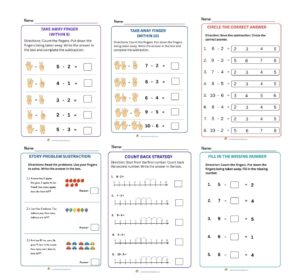
What Are Finger Subtraction Worksheets?
Finger Subtraction Worksheets teach children to solve subtraction problems by using their fingers as visual models.
The steps are simple:
- Show the starting number using your fingers.
- Put down the fingers being taken away.
- Count the fingers that remain.
- Write the answer in the box.
Directions
Count the fingers. Put down the fingers being taken away. Write the answer in the box and complete the subtraction.
Example:
🖐️ – ✌️ = 7
7 − 2 = □
Fold down 2 fingers.
Count the remaining fingers.
Answer:
5
This method helps children understand the meaning of subtraction instead of memorizing answers.
Why Teach Subtraction Using Fingers?
Young learners understand math best when they can see and touch quantities.
Using fingers helps children:
- Understand subtraction as taking away
- Develop strong number sense
- Improve counting backward skills
- Build confidence in solving math problems
- Prepare for mental subtraction
- Strengthen problem-solving abilities
As children practice, they gradually rely less on their fingers and begin solving problems mentally.
Finger Subtraction Within 5
Children first practice subtraction within 5 using one hand.
Examples:
- 5 − 1 = 4
- 5 − 2 = 3
- 4 − 1 = 3
- 3 − 2 = 1
- 2 − 1 = 1
These simple exercises help children understand that subtraction means removing part of a group.
Finger Subtraction Within 10
After mastering subtraction within 5, children move on to subtraction within 10 using both hands.
Examples:
- 8 − 2 = 6
- 9 − 4 = 5
- 10 − 3 = 7
- 7 − 2 = 5
- 6 − 1 = 5
Children begin to recognize subtraction patterns and no longer need to count every finger.
What Is Included in These Finger Subtraction Worksheets?
This printable worksheet pack contains ten engaging activities.
1. Take Away Fingers (Within 5)
Children practice simple subtraction using one hand.
2. Finger Subtraction Within 10
Students solve subtraction problems using both hands.
3. Count the Remaining Fingers
Children count the fingers left after taking some away.
4. Count Back Strategy
Students learn to count backward from the starting number.
5. Hidden Fingers Challenge
Children figure out how many fingers have been hidden or taken away.
6. Story Problem Subtraction
Simple word problems help children apply subtraction in everyday situations.
7. Circle the Correct Answer
Multiple-choice subtraction questions strengthen understanding.
8. Fill in the Missing Number
Children solve missing-number subtraction equations.
9. Mixed Finger Subtraction Review
A variety of subtraction problems provide extra practice.
10. Stage 6 Assessment
A review worksheet checks children’s understanding of subtraction within 10.
Learning Objectives
After completing these Finger Subtraction Worksheets, children will:
- Understand subtraction as taking away
- Subtract within 5
- Subtract within 10
- Count backward correctly
- Build number sense
- Improve mental computation
- Gain confidence in mathematics
Stage 6 of the Kindergarten Mind Computation Using Fingers Program
Our finger math program follows a structured learning path.
Stage 1 – Number Recognition and Finger Counting
Children learn to recognize numbers and show them using their fingers.
Practice with:
- Finger Counting Worksheets
- Counting Worksheets
- Number Matching Worksheets
Stage 2 – Number Bonds to 5
Children discover number partners that make 5.
Stage 3 – Number Bonds to 10
Children learn combinations that make 10.
Stage 4 – Finger Addition Within 5 and 10
Children count the fingers, write the answer, and complete the addition sentence.
Stage 5 – Counting On Strategy
Children begin addition by starting with the larger number and counting forward.
Stage 6 – Finger Subtraction Within 10
(Current Lesson)
Children now learn to:
- Show the starting number.
- Put down the fingers being taken away.
- Count the remaining fingers.
- Complete subtraction equations.
- Build confidence with subtraction.
This stage prepares children for more advanced mental subtraction strategies.
Tips for Parents and Teachers
Help children succeed by:
- Practicing for 10–15 minutes each day.
- Using real fingers before worksheets.
- Encouraging children to explain their answers.
- Playing subtraction games.
- Reviewing previous lessons regularly.
- Celebrating progress and effort.
Consistent daily practice leads to stronger mental math skills.
Continue Learning
After mastering finger subtraction, continue with:
- Stage 7 – Doubles and Near Doubles
- Stage 8 – Make Ten Strategy
- Stage 9 – Hidden Fingers Challenge
- Stage 10 – Mental Computation Without Fingers
Each stage helps children become faster, more accurate, and more confident mathematicians.
Related Printable Math Resources
Explore more free printable worksheets:
Numbers & Counting
Addition Practice
- Finger Addition Worksheets
- Addition Worksheets
- Kindergarten Addition Worksheets
- Adding with Pictures Worksheets
- Beginning Addition Worksheets
Subtraction Practice
Number Writing
Frequently Asked Questions
What age is suitable for finger subtraction?
Most children between 5 and 6 years old are ready to begin subtraction within 10 after learning addition and number bonds.
Why use fingers to teach subtraction?
Fingers help children understand subtraction visually. As they gain confidence, they naturally transition from finger counting to mental subtraction.
Should children count backward?
Yes. Counting backward is an important early subtraction strategy that helps children understand how numbers decrease.
These Finger Subtraction Worksheets provide an enjoyable and effective way to teach subtraction within 10. By counting the fingers, putting down the fingers being taken away, and writing the answer, children build a strong understanding of subtraction before moving to mental math.
With consistent practice, children develop confidence, improve number sense, and build the foundation needed for future success in mathematics.

Will Gab is the creator of Arianne Learning Printables. He started designing worksheets to support his daughter’s kindergarten learning journey. What began as a personal project has grown into a free educational resource for parents, teachers, and children around the world.
Will Gab continues to develop printable activities based on the skills young children need as they prepare for kindergarten and early elementary school.
Related Worksheets:
 Let’s Practice Subtraction: A Beginner’s Guide Using Pictures for Kids
 Number Bonds to 5 Worksheets for Kindergarten (Free Printable Finger Math Activities)
 Number Bonds to 10 Worksheets for Kindergarten (Free Printable Finger Math Activities)
 Finger Addition Worksheets Within 5 and 10 for Kindergarten
 Counting On Worksheets for Kindergarten (Addition Within 10 Using Fingers)
 Beginning Addition Worksheets – Count and Add Pictures | Preschool & Early Elementary Math