
Free CVC word worksheets help beginning readers connect letters with sounds and blend those sounds into complete words. CVC means consonant-vowel-consonant, the pattern used in short words such as cat, bed, pig, log, and sun. Because the pattern is regular and easy to hear, it is an excellent bridge between knowing individual letter sounds and reading independently.
This collection is designed for kindergarten learners who already recognize most lowercase letters and can say common consonant sounds. Each printable gives children focused practice with one short-vowel pattern before they mix several vowels together.
Free CVC Word Worksheets by Short Vowel
Choose the vowel pattern your child is currently learning. It is usually best to begin with one vowel and practice it across several short sessions.
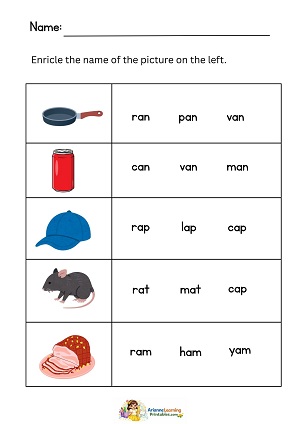
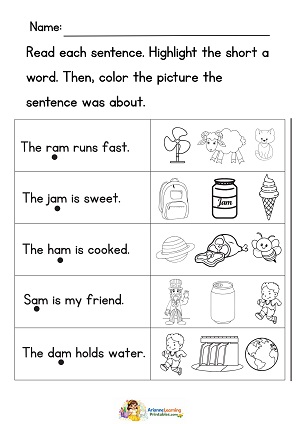
- Short A: Practice words such as cat, map, hat, and van with our CVC short A worksheets.
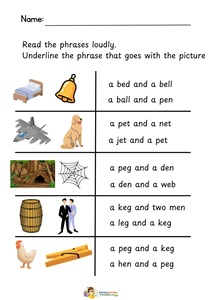
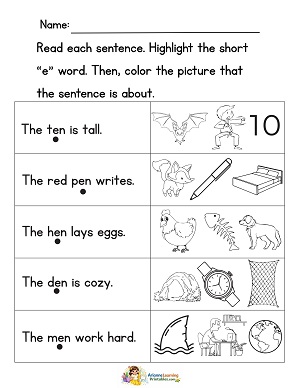
- Short E: Read words such as bed, hen, jet, and red using the CVC short E worksheets.
- Short I: Build accuracy with pig, sit, fin, and lid in the CVC short I worksheets.
- Short O: Blend dog, log, pot, and fox with the CVC short O worksheets.
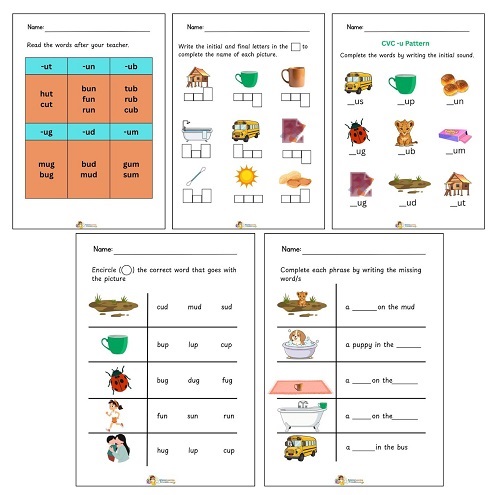
- Short U: Practice sun, cup, bug, and run using the CVC short U worksheets.
What Children Learn from CVC Words
CVC practice teaches more than a list of three-letter words. Children learn that print follows a left-to-right sequence and that changing one letter changes a word. For example, changing the first sound in map creates cap, while changing the middle vowel creates mop. This flexible attention to every sound supports both reading and spelling.
A learner is ready for CVC blending when they can usually produce the sounds for the letters in a word without a long pause. If identifying each letter is still difficult, spend a little more time with our alphabet worksheets and beginning-sounds activities before expecting fluent blending.
A Simple Five-Step Blending Routine
- Name the picture only after attempting the word. Pictures can confirm meaning, but they should not replace reading.
- Point under each letter. Ask the child to say the sound, not the letter name: /c/ /a/ /t/.
- Blend without stopping. Stretch the first two sounds and move smoothly to the last: “ccaaat.” Avoid adding an “uh” after consonants.
- Say the whole word naturally. After blending, repeat “cat” at normal speaking speed and use it in a short sentence.
- Write or build the word. Ask the child to say each sound while writing its matching letter or arranging letter tiles.
Teaching Observations That Matter
Listen closely to how a child reaches an answer. A correct word is not always evidence of decoding. If the learner looks at the picture and says “dog” without attending to the letters, cover the picture temporarily and guide a sound-by-sound attempt. When the word has been read, uncover the picture to check meaning.
Some children can say three separate sounds but lose the first sound before finishing. Continuous sounds such as /m/, /s/, /f/, and /n/ are helpful starting consonants because they can be stretched into the vowel. Begin with words such as map, sun, and fin, then introduce words beginning with stop sounds such as /b/, /d/, and /t/.
Common CVC Reading Mistakes
- Adding extra sounds: saying “buh-a-tuh” makes blending difficult. Model the clean sounds /b/ /a/ /t/.
- Guessing from the first letter: remind the learner to check the middle and final sounds.
- Relying on pictures: use pictures to confirm the word only after decoding.
- Mixing every vowel too soon: practice one short vowel until it is familiar, then compare two vowels.
- Repeating only memorized word families: mix word endings so the child must attend to all three letters.
CVC Word Mastery Checklist
Before moving to more complex phonics patterns, check whether the child can:
- Say the sound represented by each letter in a CVC word.
- Blend an unfamiliar three-letter word without using a picture clue.
- Identify the middle vowel sound.
- Segment a spoken word such as sun into three sounds.
- Write a simple CVC word after hearing it.
- Read several mixed CVC words accurately on two different days.
How Often Should Children Practice?
Short, frequent lessons are most useful. Practice for about five to ten minutes, four or five times each week. Start with four to six words from one vowel family. When those words are accurate, mix in new endings and previously learned vowels. Stop before the child becomes tired; one successful page is more valuable than several rushed pages.
Move from Words to Short Sentences
Once individual words are secure, place them in short, understandable sentences. Try our short A sentence worksheets and short E sentence worksheets. Ask the child to reread each sentence smoothly and explain what it means. This prevents phonics practice from becoming disconnected from comprehension.
Build a Balanced Early Reading Routine
Combine CVC decoding with oral language, shared reading, and handwriting. Explore the full phonics and reading collection, use the sight word worksheets for common high-frequency words, and reinforce pencil control through the writing and tracing hub. These connected activities help children move from isolated sounds to meaningful reading.