
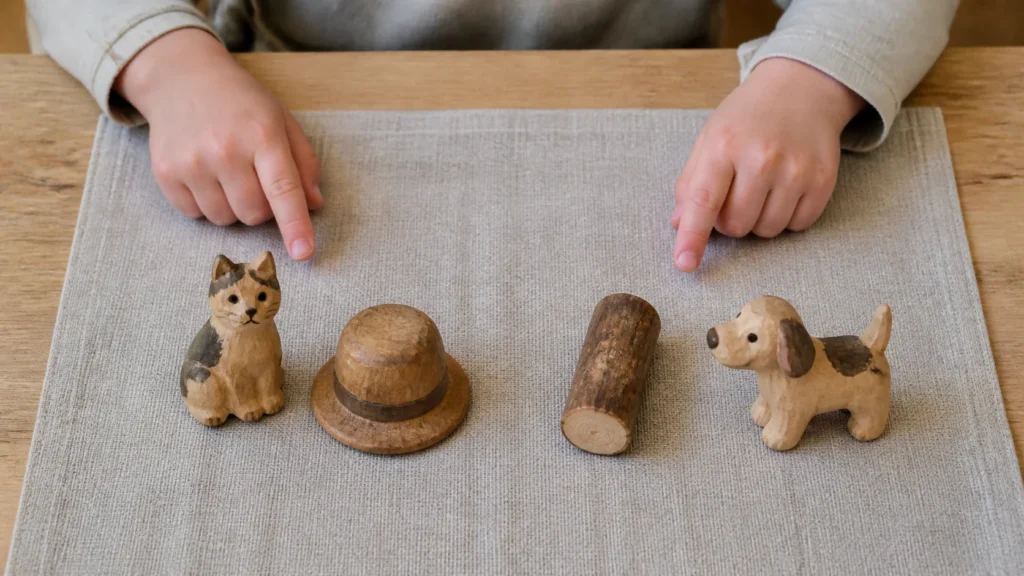
Rhyming helps children listen to word endings and notice sound patterns. Cat and hat rhyme because they share the ending sound /at/. This skill supports later decoding because children begin to recognize that changing the first sound can create a new word in the same word family.
Keep the first lessons oral and playful. Children do not need to read the words before they can decide whether they rhyme.
What Makes Two Words Rhyme?
Words rhyme when their ending sounds match. Dog and log rhyme. Sun and fun rhyme. Words do not rhyme simply because their first letters match.
Say each pair naturally, then emphasize the endings: c-at, h-at. Ask the child whether the ending sounds are the same.
Begin With Two Choices
Show a cat picture and offer hat or dog as a match. Name all pictures so vocabulary does not become the difficulty. Ask, “Which word sounds like cat at the end?”
Once the child can choose a rhyme, ask them to produce one. Accept playful nonsense words when the goal is sound awareness. A made-up word can still rhyme.
Use the Say-Pause-Match Routine
- Say the target word clearly.
- Pause so the child can hold its ending sound in mind.
- Say two choices.
- Repeat the matched pair together.
Start with familiar one-syllable words and clear families such as -at, -og, -an, and -op.
Download the Free Rhyming Words Worksheet
Easy Rhyming Games
Rhyme Basket
Place a small object in a basket and ask for a word that rhymes with its name. Use picture choices when children need support.
Finish the Rhyme
Say, “A cat wears a…” and let the child complete hat. Keep the sentences silly and predictable.
Rhyme or Not?
Say two words. The child gives a thumbs-up if they rhyme and a thumbs-down if they do not.
Word-Family Train
Start with cat and take turns adding rhymes: hat, mat, sat, bat. Stop when ideas run out, then choose a new family.
Common Difficulties
A child may choose words with the same beginning sound. Contrast alliteration and rhyme: cat and cup start the same, while cat and hat end the same.
Some children cannot rhyme a picture because they use a different name for it. Always agree on the picture’s name before comparing sounds.
Frequently Asked Questions
Do spelling patterns always match?
No. Rhyming is about sound. Words can rhyme even when their spellings differ.
Are nursery rhymes useful?
Yes. Pause before a rhyming word and invite the child to predict it.
Should nonsense rhymes be accepted?
Yes during oral sound play. Producing “lat” for cat shows the child understands the sound pattern, even though lat is not a regular English word.
Final Thoughts
Rhyming grows through hearing and saying word pairs repeatedly. Use familiar pictures, emphasize endings, and celebrate careful listening. Repeat the worksheet button here before the author box.

Will Gab is the creator of Arianne Learning Printables. He started designing worksheets to support his daughter’s kindergarten learning journey. What began as a personal project has grown into a free educational resource for parents, teachers, and children around the world.
Will Gab continues to develop printable activities based on the skills young children need as they prepare for kindergarten and early elementary school.
Related Worksheets:
 Sight Word “And” Worksheet – Read, Write, Trace and Color Activity
 Sight Word “Him” Worksheet – Read, Trace, Write, and Color Printable Activity
 Sight Word “His” Worksheet – Read, Trace, Write, and Color Printable Activity
 Sight Word “if” Worksheet – Read, Write, Trace and Color Activity.
 Sight Word “with” Worksheet – Read, Write, Trace and Color Activity.
 Master Phonics with Free CVC Short E Words Worksheets