
This stage is the final step in our finger-math sequence. Children no longer need to raise and count their fingers for every problem. Instead, they picture familiar finger patterns, number bonds, doubles, or make-ten relationships and use those mental images to find an answer.
This stage builds directly on Hidden Fingers and completes our Kindergarten Mind Computation Using Fingers guide.
What Does Mental Computation Without Fingers Mean?
Mental computation means solving a number problem in the mind without writing every step or physically counting objects. It should involve small, familiar quantities and strategies they already understand.
For 4 + 3, a child might picture four fingers and three more, recognize a near double, or think 4 + 4 and take one away. For 8 – 5, the child might picture eight fingers and imagine one full hand folding down.
The goal is flexible thinking, not speed drills.
Signs a Child Is Ready for Stage 10
A child is likely ready when they can recognize finger quantities without counting one by one, recall many number bonds to five and ten, count on from a larger number, and explain simple addition or subtraction strategies.
If these skills are not yet consistent, return to the earlier stages. Our Make Ten Strategy worksheets provide useful review.
How to Teach Mental Computation
1. Show, cover, and remember
Briefly show a finger pattern or group of counters. Cover it and ask the child to say what they saw. This builds a clear mental image before calculation is added.
2. Ask for a mental picture
Present an easy fact such as 3 + 2. Ask the child to keep both hands resting and describe the finger groups they imagine.
3. Compare strategies
Two children may solve the same problem differently. One might use a number bond while another sees a double. Discussing both methods develops flexibility.
4. Use short story problems
Simple stories give numbers meaning: “There are six crayons. Two more are added. How many are there now?” Let the child picture the objects and explain the operation.
Free Stage 10 Mental Computation Worksheet
This six-page A4 printable includes visual-memory warm-ups, mental addition and subtraction within ten, strategy choices, mixed facts, and story problems.
Download the free Stage 10 Mental Computation worksheets
Print at 100% on A4 paper. A short page completed thoughtfully is more useful than rushing through the entire packet.
Keep Mental Math Positive
- Allow quiet thinking time before asking for an answer.
- Encourage children to explain their method.
- Use facts within ten until confidence is strong.
- Avoid timing a child who feels anxious.
- Let children return to fingers when they need to check.
Needing fingers occasionally is not failure. Fingers remain a useful mathematical tool even after mental strategies begin.
Frequently Asked Questions
Should kindergarten mental math be timed?
Usually not. Accuracy, understanding, and confidence matter more than speed. Fluency grows naturally through brief, repeated practice.
What if my child still uses fingers?
Continue allowing them while asking what patterns they notice. Gradually invite the child to picture the fingers before showing them.
Which facts should we practice first?
Begin with number bonds to five, doubles, adding one, subtracting one, and combinations the child already understands.
A Strong Finish to the Finger-Math Sequence
It does not ask children to forget their fingers. It teaches them to carry those useful patterns into their minds. With patient practice, concrete finger counting becomes flexible and confident mental computation.
Download the free Stage 10 Mental Computation worksheets

Related Worksheets:
 Finger Addition Worksheets Within 5 and 10 for Kindergarten
 Counting On Worksheets for Kindergarten (Addition Within 10 Using Fingers)
 Beginning Addition Worksheets – Count and Add Pictures | Preschool & Early Elementary Math
 Number Bonds to 10 Worksheets for Kindergarten (Free Printable Finger Math Activities)
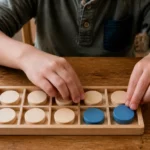 Make Ten Strategy for Kindergarten: A Simple Finger Math Guide
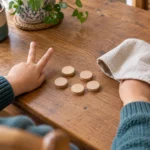 Hidden Fingers Worksheets for Kindergarten: Stage 9 Mental Math