
The letter L tracing worksheet is a cornerstone of early penmanship, offering a perfect blend of simplicity and structural importance. While it may look like just two lines, the letter L is simple but important because it teaches children how to create clean corners and angles, which are essential for mastering a wide variety of other letters in the alphabet.
By focusing on the “L,” young learners move beyond single-stroke marks and begin to understand how separate movements join together to create a cohesive geometric shape.
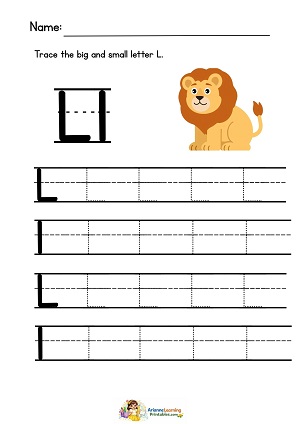
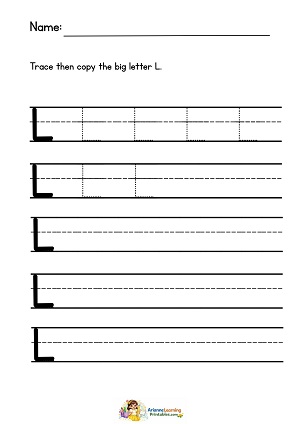
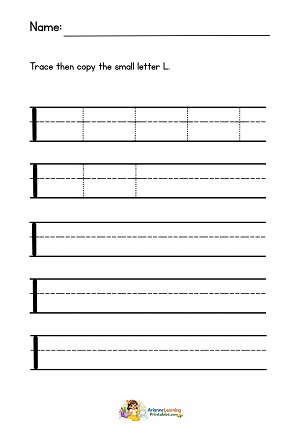
Why the Letter L is a “Cornerstone” of Handwriting
In the developmental hierarchy of writing, the “L” serves as a bridge between the basic verticality of the letter “I” and more complex, multi-stroke characters. Here is why this specific letter is so vital for fine motor development:
- Learning the 90-Degree Turn: The defining feature of an uppercase “L” is the sharp, right-angle turn at the bottom. Mastering this “corner” helps children develop pencil braking skills—the ability to stop a downward motion and immediately transition into a horizontal one without lifting the pencil or rounding the edge.
- Developing Structural Proportion: The letter L helps children understand the relationship between height and width. Learning to make the vertical “back” taller than the horizontal “foot” is a great exercise in spatial awareness and visual scaling.
- Essential for Many Letters: The skills learned here are universal. The “cornering” technique practiced with the letter L is a prerequisite for forming letters like E, F, H, and even the “seating” of a letter like B or D.
Strengthening Pencil Control Through Intentional Practice
Using a letter L tracing guide provides children with the “track” they need to stay within the lines while they practice their grip and pressure. Without this guided practice, many children tend to “curve” the corner, turning the L into a soft hook. Tracing ensures they learn the clean angles necessary for legible, professional-looking handwriting.
Instructional Pro-Tip: Encourage your student to “count the stops.” For the letter L, they go “Down, stop, over!” This verbal cue reinforces the idea that a corner is a deliberate change in direction, not a continuous curve.
Developmental Milestones Achieved with Letter L Practice
| Handwriting Goal | Educational Benefit |
| Corner Precision | Teaches the child to change direction at a sharp 90-degree angle. |
| Horizontal Alignment | Ensures the “foot” of the letter sits perfectly on the baseline. |
| Fine Motor Stability | Builds the strength required to maintain a straight path without “wobbling.” |
Preparing for Future Writing Success
Whether you are a teacher in a classroom setting or a parent working on homeschooling worksheets, the letter L provides a low-stress environment for children to perfect their technique. Because the letter is easy to recognize and quick to complete, it builds the confidence necessary to tackle more intimidating letters later on.
By mastering the clean corners and sharp angles of the letter L, your child is doing much more than learning one character—they are mastering the geometry of the entire English alphabet.
When your students are practicing, do they struggle more with keeping the vertical line straight, or do they tend to make the “foot” of the L a bit too long?
🎯 Focus Skills
- Straight vertical line
- Horizontal base
- Sharp corner formation
✍️ Teaching Steps
- Draw a vertical line down
- Add a horizontal line at the bottom
🎮 Activity: “Draw Corners”
Let your child practice drawing L shapes around the page.
⚠️ Common Mistakes
- Rounded corners instead of sharp angles
- Uneven lines
- Incorrect starting point
📊 Difficulty: Easy
🔗 Continue Learning
- letter m tracing worksheet uppercase and lowercase m
- benefits of tracing worksheets for preschool and kindergarten

Will Gab is the creator of Arianne Learning Printables. He started designing worksheets to support his daughter’s kindergarten learning journey. What began as a personal project has grown into a free educational resource for parents, teachers, and children around the world.
Will Gab continues to develop printable activities based on the skills young children need as they prepare for kindergarten and early elementary school.
Related Worksheets:
 How to Teach Letter A Tracing (Free Printable Worksheet for Preschoolers)
 How to Teach Letter E Tracing (Free Printable Worksheet for Preschoolers)
 How to Teach Letter F Tracing (Free Printable Worksheet for Preschoolers)
 How to Teach Letter Q Tracing (Free Printable Worksheet for Preschoolers)
 How to Teach Letter R Tracing (Free Printable Worksheet for Preschoolers)
 How to Teach Letter Recognition: A Complete Guide for Parents and Teachers
Pingback: How to Teach Letter M Tracing (Free Printable Worksheet for Preschoolers) - Arianne Learning Printables Letter M Tracing Worksheet for Preschool (Free Printable + Guide)