
The letter K tracing worksheet is a pivotal milestone in a child’s handwriting development. While letters like “L” or “T” focus on simple vertical and horizontal planes, the letter K is a great way to teach children how to handle diagonal lines and direction changes, which are considered more advanced writing skills. Moving from straight blocks to slanted strokes requires a higher level of cognitive planning and physical dexterity.
After learning straight lines, children are ready for more dynamic shapes like letter j tracing worksheet uppercase lowercase j.
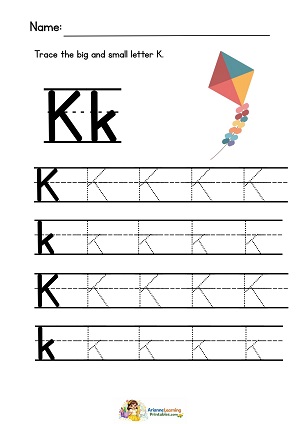
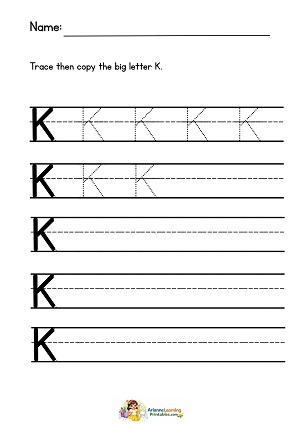
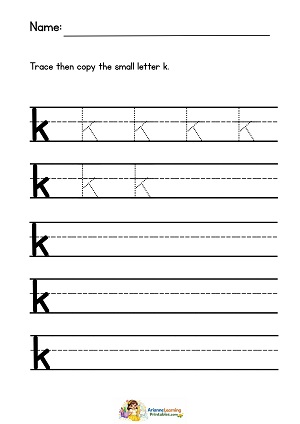
Why the Letter K is a “Power Letter” for Fine Motor Skills
In the progression of learning to write, diagonal lines represent a significant leap in visual-motor integration. The letter K challenges a child to move their pencil in three distinct directions, making it an essential exercise for school readiness.
- Mastering the Diagonal Stroke: Unlike vertical lines that go straight down, diagonal lines require the child to move across the horizontal and vertical axes simultaneously. This helps develop the “oblique” movements necessary for more complex characters like “X,” “Y,” and “R.”
- Precision at the Intersection: One of the trickiest parts of the letter K is the meeting point—the “vertex.” Children must learn to aim their diagonal lines so they meet the vertical spine at exactly the right spot. This builds incredible eye-hand coordination and spatial judgment.
- Complex Direction Changes: Writing a “K” involves lifting the pencil or pausing to change the angle of the stroke mid-way. These direction changes teach children how to navigate the paper with intent, rather than just drawing random lines.
Strengthening the Writing Foundation
Using a letter K tracing guide provides the structure needed to conquer these “slanty” lines without frustration. By following guided arrows, children learn the proper stroke order: first the long vertical “backbone,” followed by the two kicking legs.
Parent & Teacher Tip: Try describing the letter K as a “tree with two branches reaching out.” This helps children visualize the angles and encourages them to keep the “legs” of the K connected to the main “trunk.”
Key Developmental Benefits of Letter K Practice
| Handwriting Skill | Why It Matters |
| Oblique Line Control | Prepares the hand for cursive writing and complex drawing shapes. |
| Point of Convergence | Teaches the child how to join two lines at a specific intersection. |
| Pencil Braking | Improves the ability to stop a stroke at a precise point to prevent “over-shooting.” |
Transitioning to Advanced Penmanship
Because the letter K introduces such unique geometric challenges, it is often a favorite for improving overall legibility. Once a child can control the slanted lines of a “K,” they often show immediate improvement in their ability to draw shapes and stay within the lines of other difficult letters.
Incorporating letter K worksheets into your lesson plan ensures that your students are not just memorizing the alphabet, but are actually mastering the physics of writing. By tackling these advanced writing skills early on, you are setting the stage for a lifetime of fluid, confident penmanship.
Do your students usually find it easier to draw the “kick” going up toward the top line or the one “sliding” down to the bottom?
🎯 Focus Skills
- Diagonal strokes
- Changing direction
- Line connection
✍️ Teaching Steps
- Draw a vertical line
- Add an upper diagonal line
- Add a lower diagonal line
🎮 Activity: “Connect the Lines”
Draw separate lines and let your child connect them into K.
⚠️ Common Mistakes
- Uneven diagonals
- Lines not meeting correctly
- Incorrect angles
📊 Difficulty: Medium
🔗 Continue Learning

Will Gab is the creator of Arianne Learning Printables. He started designing worksheets to support his daughter’s kindergarten learning journey. What began as a personal project has grown into a free educational resource for parents, teachers, and children around the world.
Will Gab continues to develop printable activities based on the skills young children need as they prepare for kindergarten and early elementary school.
Related Worksheets:
 How to Teach Letter A Tracing (Free Printable Worksheet for Preschoolers)
 How to Teach Letter E Tracing (Free Printable Worksheet for Preschoolers)
 How to Teach Letter F Tracing (Free Printable Worksheet for Preschoolers)
 How to Teach Letter Q Tracing (Free Printable Worksheet for Preschoolers)
 How to Teach Letter R Tracing (Free Printable Worksheet for Preschoolers)
 How to Teach Letter Recognition: A Complete Guide for Parents and Teachers
Pingback: How to Teach Letter J Tracing (Free Printable Worksheet for Preschoolers) - Arianne Learning Printables Letter J Tracing Worksheet (Free Printable + Writing Guide)