
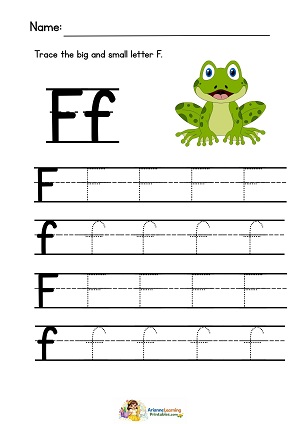
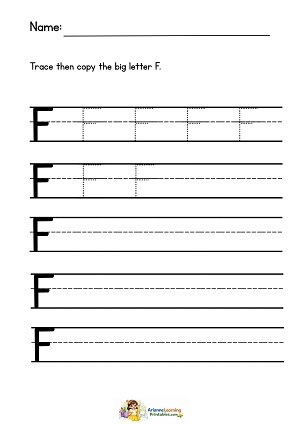
The letter F tracing worksheet is a vital tool in any early childhood literacy curriculum. While it shares many structural similarities with the letter E, the uppercase “F” presents a unique challenge that helps young learners refine their fine motor skills and spatial judgment. By focusing on the letter F, children transition from basic mark-making to intentional, precise penmanship.
Why the Letter F is Key for Handwriting Precision
In the world of preschool and kindergarten writing, the letter F is a masterclass in proportion and placement. Unlike more symmetrical letters, the F requires a specific internal logic to look “correct.”
- Practicing Precision: The letter F helps children practice precision, especially when placing the horizontal lines. Because the “F” only has two crossbars compared to the “E’s” three, the spacing becomes even more critical for visual balance.
- Controlling Stroke Length: One of the most important lessons the letter F teaches is the difference in line length. A properly formed “F” features a top bar and a slightly shorter middle bar. Learning to stop a stroke intentionally—rather than just drawing until the pencil hits the edge of the paper—is a major milestone in manual dexterity.
- Vertical Stability: Before the horizontal bars can be placed, the child must master the long vertical “spine.” This reinforces the foundational top-to-bottom writing habit that is essential for all English characters.
Structural Literacy and Pencil Control
Using a letter F tracing guide allows children to repeat these specific motions until they become muscle memory. This repetition is not just about the alphabet; it’s about training the brain to coordinate with the small muscles in the hand.
Teaching Tip: When guiding a student, call the vertical line the “flagpole” and the horizontal lines the “flags.” This helps children visualize the structure and makes the lesson on shorter horizontal lines more engaging and memorable.
Developmental Benefits of Letter F Practice
- Visual Discrimination: Helps children distinguish between similar-looking letters (like E and F), which is a key component of early reading fluency.
- Hand-Eye Coordination: Aligning the middle bar exactly to the center of the vertical line requires significant focus and ocular tracking.
- Confidence Building: Because the “F” is composed of fewer strokes than many other letters, children can master it quickly, providing a sense of accomplishment that encourages them to keep practicing.
Integrating the Letter F into Daily Learning
Whether you are using printable worksheets or a digital tracing app, the goal is consistent, quality practice. Focusing on the “F” ensures that children don’t just learn to draw lines, but learn to draw them with intent and accuracy. By mastering the delicate balance of the letter F, students prepare themselves for more complex characters that require even greater levels of control and spatial awareness.
Since the letter F is so closely related to the letter E, do you find your students tend to add that extra bottom line by habit, or are they picking up the difference quickly?
🎯 Focus Skills
- Line placement
- Short vs long strokes
- Control
✍️ Teaching Steps
- Draw vertical line
- Add top horizontal line
- Add shorter middle line
🎮 Activity: “Highlight the Lines”
Let your child trace using different colors.
⚠️ Common Mistakes
- Middle line too long
- Wrong positioning
📊 Difficulty: Easy
🔗 Continue Learning
Teach the Letter F Sound
Letter F usually represents the quiet, continuous /f/ sound heard at the beginning of fish, fan, fox, and five. Invite the child to place a hand in front of the mouth and feel the gentle air while saying /f/. Keep the sound short and avoid adding “uh,” which can make blending harder later.
How to Form Uppercase and Lowercase F
- Uppercase F: Draw one long line down, return to the top for a long line across, then add a shorter middle line.
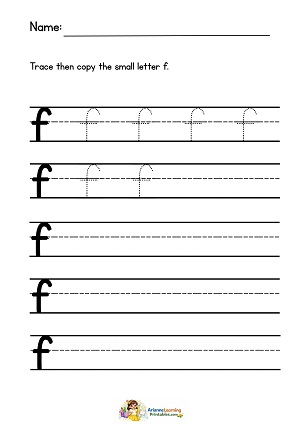
- Lowercase f: Begin above the middle line, curve down through the writing line, then add the crossbar.
If a child reverses the top stroke, place a starting dot at the upper left and use the words “down, across, across.” Finish with a quick search for F in a book title or food label. When the child can name, sound, and form F independently, continue to the Letter G tracing lesson or visit the complete alphabet practice hub.

Will Gab is the creator of Arianne Learning Printables. He started designing worksheets to support his daughter’s kindergarten learning journey. What began as a personal project has grown into a free educational resource for parents, teachers, and children around the world.
Will Gab continues to develop printable activities based on the skills young children need as they prepare for kindergarten and early elementary school.
Related Worksheets:
 How to Teach Letter A Tracing (Free Printable Worksheet for Preschoolers)
 How to Teach Letter E Tracing (Free Printable Worksheet for Preschoolers)
 How to Teach Letter G Tracing (Free Printable Worksheet for Preschoolers)
 How to Teach Letter Q Tracing (Free Printable Worksheet for Preschoolers)
 How to Teach Letter R Tracing (Free Printable Worksheet for Preschoolers)
 How to Teach Letter Recognition: A Complete Guide for Parents and Teachers
Pingback: How to Teach Letter E Tracing (Free Printable Worksheet for Preschoolers) - Arianne Learning Printables Letter E Tracing Worksheet for Preschool (Free Printable + Guide)
Pingback: Alphabet Letter Tracing Worksheets A–Z - Arianne Learning Printables Alphabet Letter Tracing Worksheets A-Z | Free Printable Alphabet Practice