
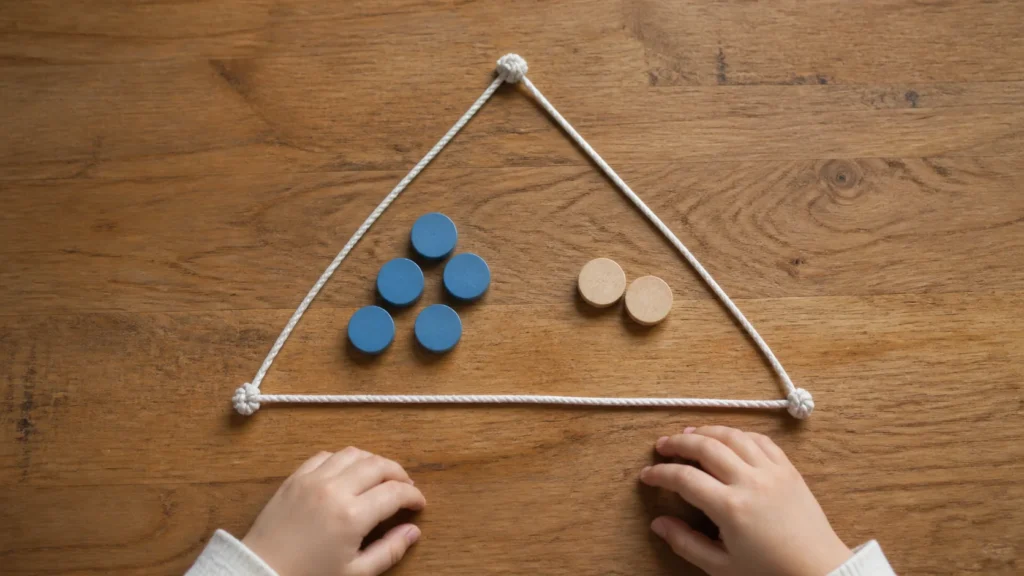
Fact families help children see how addition and subtraction are connected. Instead of learning four separate equations, kindergarten students work with the same three numbers and discover how the parts and whole fit together.
For example, 5, 2, and 7 belong to one fact family. Five and two make seven. If two are taken away from seven, five remain. This relationship is easier to understand when children can move real objects before writing number sentences.
What Is a Fact Family?
A fact family is a group of related addition and subtraction facts using the same three numbers. With 3, 4, and 7, the family is:
- 3 + 4 = 7
- 4 + 3 = 7
- 7 – 3 = 4
- 7 – 4 = 3
The largest number is the whole. The two smaller numbers are its parts. Keeping that language consistent helps children avoid putting the whole in the wrong place.
Begin With Counters
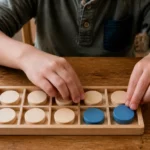
Place five blue counters and two wooden counters on the table. Ask the child to count each color, then push both groups together and count the whole.
Say, “Five and two make seven.” Switch the order of the groups and say, “Two and five also make seven.” Next, remove the two wooden counters. Ask how many remain.
Do not rush into four written equations. Let the child repeat the actions until joining and separating the groups make sense.
Use a Number-Bond Triangle
Draw a simple triangle with one circle at each corner. Put 7 at the top because it is the whole. Put 5 and 2 in the lower corners because they are the parts.
Cover one corner and ask which number is missing. This turns the fact family into a quick reasoning game and connects naturally with missing addends within 10.
A Simple Teaching Routine
Use this sequence for each new family:
- Build two parts with counters.
- Join the parts and count the whole.
- Separate one part from the whole.
- Say all four related facts aloud.
- Write the four equations.
Start with totals of five or less, then move toward ten. Families such as 1, 4, 5 and 2, 3, 5 are good first examples.
Download the Free Fact Families Worksheet
Easy Fact-Family Games
Shake and Split
Put a small number of two-color counters in a cup. Shake and spill them. Count each color and name the whole, then say the related facts.
Cover a Number
Write the three family numbers on cards. Hide one card and ask the child to identify the missing part or whole.
Build It With Toys
Use toy cars, blocks, or small animals. Create two groups, combine them, and then tell a short subtraction story by moving one group away.
Common Difficulties
If a child writes the largest number as an addend, return to the words parts and whole. Physically join the parts and point to the complete group.
If subtraction facts feel harder, act them out rather than asking the child to memorize them. The goal is to understand what remains after one part is removed.
Frequently Asked Questions
Do kindergarten children need all four equations?
They can explore all four, but understanding the relationship is more important than writing quickly. Some learners may begin with two addition facts before adding subtraction.
Are fact families the same as number bonds?
They are closely related. A number bond shows the parts and whole; a fact family records the addition and subtraction equations that describe them.
How long should practice last?
Five to ten minutes is enough. One or two carefully explored families are more valuable than a long page completed by guessing.
Final Thoughts
Fact families make arithmetic feel connected. When children build, join, and separate the same three numbers, addition and subtraction stop looking like unrelated rules. Keep the practice concrete, use clear parts-and-whole language, and finish with a few worksheet questions.

Will Gab is the creator of Arianne Learning Printables. He started designing worksheets to support his daughter’s kindergarten learning journey. What began as a personal project has grown into a free educational resource for parents, teachers, and children around the world.
Will Gab continues to develop printable activities based on the skills young children need as they prepare for kindergarten and early elementary school.
Related Worksheets:
 Beginning Addition Worksheets – Count and Add Pictures | Preschool & Early Elementary Math
 Let’s Practice Subtraction: A Beginner’s Guide Using Pictures for Kids
 Number Bonds to 10 Worksheets for Kindergarten (Free Printable Finger Math Activities)
 Finger Addition Worksheets Within 5 and 10 for Kindergarten
 Make Ten Strategy for Kindergarten: A Simple Finger Math Guide
 Number Bonds to 10 for Kindergarten: Easy Activities and Free Worksheet