
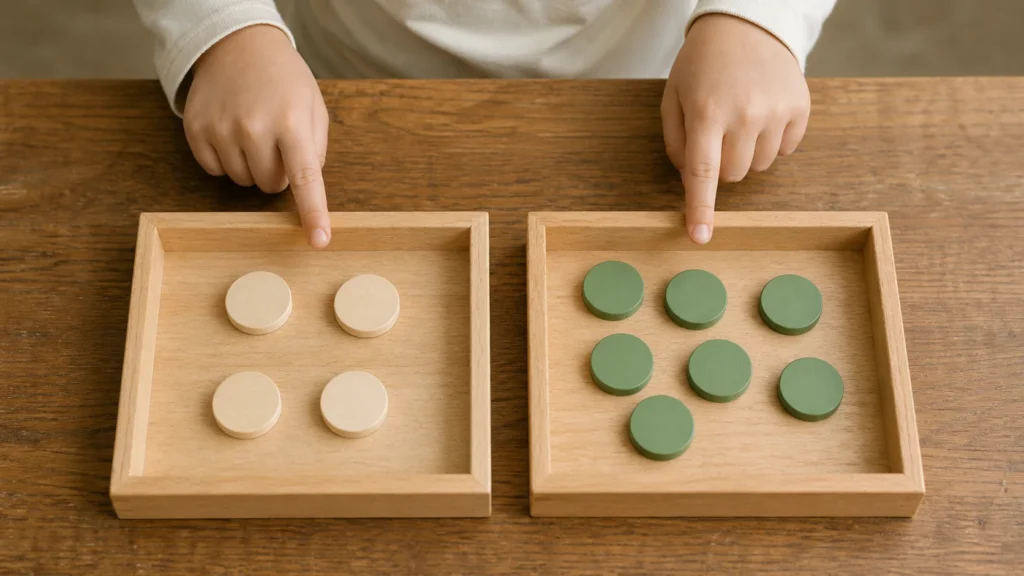
Comparing numbers helps kindergarten children understand that numbers describe quantities. Before introducing greater-than and less-than symbols, children should be able to look at two groups and explain which has more, which has fewer, or whether they are equal.
This lesson begins with real objects and simple language. Symbols come later, after the relationship is visible.
What Does Comparing Numbers Mean?
When we compare two numbers, we decide how their quantities relate:
- Greater than means a quantity has more.
- Less than means a quantity has fewer.
- Equal to means both quantities are the same.
For example, seven counters are greater than four counters because the group of seven contains more objects.
Start With Matching
Build one group of four counters and another group of seven. Ask the child to place the groups in rows, then match one counter from the first row with one counter from the second.
The row with counters left over has more. This one-to-one matching method is especially useful for children who are still developing reliable counting skills.
Ask three questions each time:
- Which group has more?
- Which group has fewer?
- How do you know?
The explanation matters because it reveals whether the child is reasoning or guessing based on spacing.
Compare Numbers on a Number Line
Show the numbers 1 through 10 on a number line. Explain that numbers farther to the right are greater. Ask the child to point to 3 and 8. Since 8 is farther to the right, it is greater than 3.
Connect the number line to objects so it does not become a memorized direction rule. Build both quantities and check.
Introduce the Symbols
Only after the language is secure, introduce >, <, and =. A helpful reminder is that the wide, open side faces the greater number, while the small point faces the smaller number.
Avoid relying only on an “alligator eats the bigger number” story. Children also need to understand the shape and read the complete comparison aloud: “Seven is greater than four.”
Download the Free Comparing Numbers Worksheet
Hands-On Comparing Games
Roll and Compare
Each player rolls a die and builds that quantity with counters. The player with the greater number keeps a point. If the groups are equal, both players receive a point.
Grab Bag
Put counters in a bag. Two players take a small handful, count, and compare their quantities. Keep totals within 10.
Build Two Towers
Make two block towers. Line them up at the bottom and compare their heights. Then count the blocks and record the number comparison.
Common Mistakes
A spread-out group can look larger even when it has fewer objects. Ask children to arrange both groups in rows or match the objects one to one.
If a child reverses the symbol, first ask them to say the comparison in words. Then place the open side toward the greater quantity.
If the child counts inaccurately, reduce the quantities and work on careful one-to-one counting before returning to symbols.
Frequently Asked Questions
When should children learn greater-than and less-than signs?
Introduce the signs after children can confidently compare real groups using more, fewer, and equal.
Is equal the same as “the answer”?
No. The equal sign means both sides have the same value. Activities with matching groups help establish this meaning.
Can this worksheet be used in math centers?
Yes. It works for independent practice after a hands-on lesson, small-group instruction, or home review.
Final Thoughts
Strong comparison skills grow from quantities, not symbols alone. Let children build, match, count, and explain two groups before recording a comparison. This concrete foundation makes greater than, less than, and equal much easier to remember.

Will Gab is the creator of Arianne Learning Printables. He started designing worksheets to support his daughter’s kindergarten learning journey. What began as a personal project has grown into a free educational resource for parents, teachers, and children around the world.
Will Gab continues to develop printable activities based on the skills young children need as they prepare for kindergarten and early elementary school.
Related Worksheets:
 Beginning Addition Worksheets – Count and Add Pictures | Preschool & Early Elementary Math
 Let’s Practice Subtraction: A Beginner’s Guide Using Pictures for Kids
 Number Bonds to 10 Worksheets for Kindergarten (Free Printable Finger Math Activities)
 Finger Addition Worksheets Within 5 and 10 for Kindergarten
 Make Ten Strategy for Kindergarten: A Simple Finger Math Guide
 Number Bonds to 10 for Kindergarten: Easy Activities and Free Worksheet