
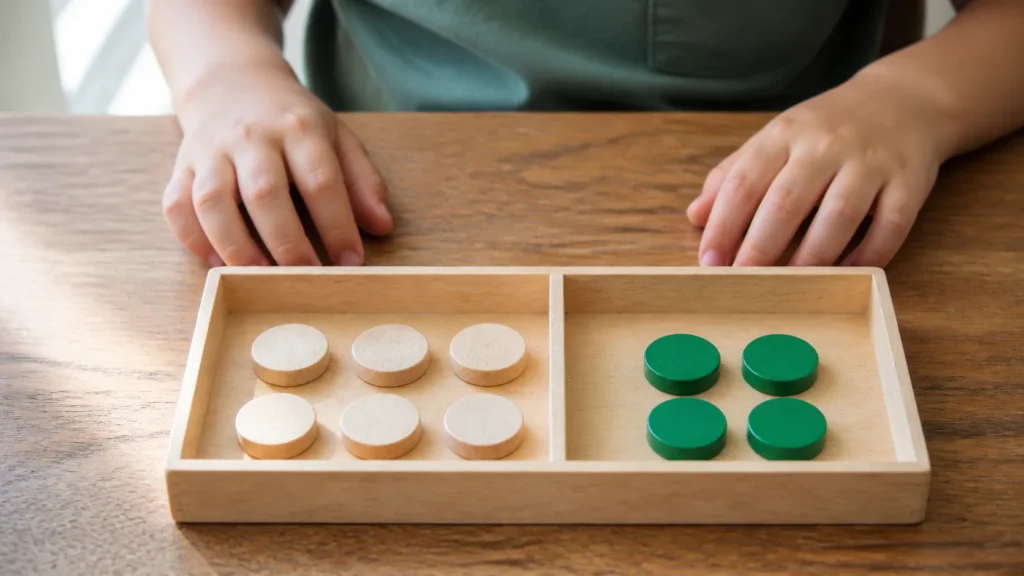
Number bonds help children see that a whole number can be separated into smaller parts. When kindergarten learners understand the pairs that make 10, they can solve addition and subtraction problems with less counting and more confidence.
This lesson uses fingers, counters, and a simple printable. Keep the first practice session short. Five to ten minutes is enough for a young learner.
What Is a Number Bond?
A number bond shows a whole and the parts that make it. For the whole number 10, the parts might be 6 and 4. We can say, “Six and four make ten.” Other useful pairs are 1 and 9, 2 and 8, 3 and 7, and 5 and 5.
Children do not need to memorize every pair immediately. They first need to build, separate, and talk about the quantity.
Start With Ten Fingers
Ask your child to hold up all ten fingers. Fold down one finger and count the fingers that remain. Say, “One and nine make ten.” Repeat by folding down two, three, and four fingers.
Turn the activity into a quick game. Show some fingers and ask, “How many more do we need to make ten?” Give the child time to look before answering. The goal is to notice the missing part, not to answer quickly.
Build Number Bonds With Counters
Place ten small objects on the table. Buttons, bottle caps, blocks, or dried beans work well. Draw two large circles on paper and ask the child to divide the ten objects between them.
After each split, count both groups and say the complete sentence together:
- “Seven and three make ten.”
- “Four and six make ten.”
- “Five and five make ten.”
Move the same objects into a new arrangement. This helps the child understand that the whole stays ten even when the parts change.
Use a Ten-Frame
A ten-frame makes the missing part easy to see. Fill six spaces and ask how many spaces are empty. Let the child place four more counters to complete the frame. Then write or say 6 + 4 = 10.
Connect this activity to the Make Ten Strategy for Kindergarten so children see how number bonds support mental addition.
Download the Free Number Bonds to 10 Worksheet
Simple Number Bond Games
Hide the Counters
Show ten counters, hide some under a cup, and leave the rest visible. Ask the child to work out how many are hidden. Reveal the counters and count to check.
Find a Partner
Write the numbers 0 through 10 on small cards. Give the child one card and ask which number would be its partner to make 10.
Make Ten at Snack Time
Put ten crackers or fruit pieces on a plate. Separate them into two groups and describe the number bond before eating them.
Common Difficulties
If a child recounts all the objects each time, continue using hands-on materials. Recounting is a normal stage. Gently draw attention to the empty spaces in the ten-frame.
If the child reverses the parts, explain that 3 and 7 still make 10, just as 7 and 3 make 10. Both arrangements describe the same whole.
Frequently Asked Questions
What age should children learn number bonds to 10?
Many children begin exploring them in kindergarten, usually around ages five to six. Readiness matters more than age.
Should children memorize the pairs?
Understanding should come first. Short, repeated games will gradually help the pairs become familiar.
Can I use this worksheet in a classroom?
Yes. It works for math centers, small groups, morning work, intervention, or home practice.
Final Thoughts
Number bonds become meaningful when children can touch and move the parts. Start with fingers and counters, then use the worksheet to record what the child already understands. A few minutes of regular practice is more useful than one long lesson.

Will Gab is the creator of Arianne Learning Printables. He started designing worksheets to support his daughter’s kindergarten learning journey. What began as a personal project has grown into a free educational resource for parents, teachers, and children around the world.
Will Gab continues to develop printable activities based on the skills young children need as they prepare for kindergarten and early elementary school.
Related Worksheets:
 Number Bonds to 5 Worksheets for Kindergarten (Free Printable Finger Math Activities)
 Number Bonds to 10 Worksheets for Kindergarten (Free Printable Finger Math Activities)
 Beginning Addition Worksheets – Count and Add Pictures | Preschool & Early Elementary Math
 Let’s Practice Subtraction: A Beginner’s Guide Using Pictures for Kids
 Finger Addition Worksheets Within 5 and 10 for Kindergarten
 Make Ten Strategy for Kindergarten: A Simple Finger Math Guide