
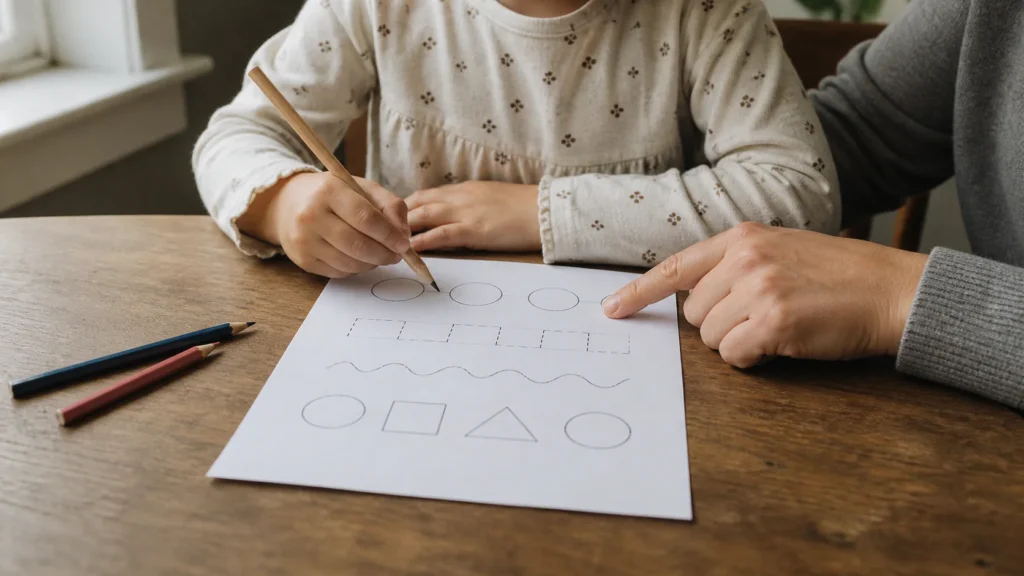
Printable worksheets can be a useful part of kindergarten learning. They give children a place to practise skills, help parents see what a child understands, and make it easy to repeat an activity when extra support is needed.
However, more worksheets do not automatically lead to more learning. A young child can become tired or frustrated when a session is too long, the page is too difficult, or an adult focuses more on finishing than understanding.
The best worksheet routine is usually simple: choose one suitable page, keep the session short, provide help without taking over, and stop before the activity becomes a struggle.
This guide explains how to use printable worksheets in a calm, age-appropriate way that supports your kindergartener’s confidence.
What Worksheets Are Good For
Worksheets are most helpful when they provide focused practice after a child has already explored a skill through conversation, play, books, or hands-on materials.
For example, before completing a counting worksheet, a child can count blocks or snack pieces. The same hands-on approach works when practising with the Kindergarten Mind Computation Using Fingers guide. Before matching beginning sounds, the child can name real objects and listen to their first sounds. The worksheet then gives the child a chance to record or review that understanding.
Printable worksheets can support:
- Number and letter recognition
- Pencil control and handwriting
- Counting and matching
- Early addition and subtraction
- Phonics and sound awareness
- Visual discrimination
- Following simple directions
- Independent work habits
A worksheet is one learning tool, not the entire lesson.
Start With One Clear Goal
Before printing a page, decide what your child will practise. A worksheet with one clear purpose is easier to understand than a page that combines several unfamiliar tasks.
A clear goal might be:
- Count groups from 1 to 10.
- Match pictures with the same beginning sound.
- Trace one type of line.
- Complete number bonds to 10.
- Compare two quantities.
Knowing the goal also helps you decide what kind of support to give. If the goal is counting, do not let coloring or handwriting difficulties prevent the child from showing what they know about quantities.
Choose the Right Difficulty
A useful worksheet should feel achievable with a small amount of effort. If every question is immediately easy, the child may not be learning anything new. If almost every question requires adult help, the page is probably too difficult for independent practice.
Look for these signs that a worksheet is a reasonable fit:
- Your child understands the direction after one explanation.
- Your child can complete at least the first question with little help.
- Most of the skill is familiar, with only a small new challenge.
- The page has enough space for young hands to write or draw.
- The amount of work looks manageable.
If the page is too difficult, put it aside without presenting that choice as a failure. Return to objects, games, or an easier printable and try the harder page another day.
Keep Worksheet Sessions Short
Kindergarten children often learn better through several brief sessions than through one long block of seated work. Five to ten focused minutes may be enough, especially after a full school day.
You do not need to finish every page in one sitting. Fold the paper to show only one section, cover later questions with another sheet, or mark a stopping point before beginning.
A simple routine might look like this:
- Spend one minute reviewing the skill with objects or conversation.
- Complete three or four worksheet questions.
- Ask the child to explain one answer.
- Stop, stretch, and move to another activity.
Stopping while your child still feels successful makes it easier to return to learning the next day.
Preview the Page Together
Before handing over the pencil, look at the worksheet with your child. Read the direction aloud and point out where to begin.
Ask your child to tell you what they think they are supposed to do. This quick check can prevent mistakes caused by misunderstanding the instructions.
Complete one example together if needed. Then let your child try the next one. Avoid demonstrating every question, because the child also needs a chance to think independently.
Use Hands-On Materials Alongside the Worksheet
Young children often need to touch and move objects before they can work with pictures or symbols on paper.
Keep simple materials nearby:
- Counters, buttons, or bottle caps for math
- Wooden or magnetic letters for phonics
- A number line for counting on
- A ten-frame for addition
- Crayons for highlighting or circling
- Small picture objects for beginning sounds or rhymes
If the worksheet asks, “7 + 3 = ?” let your child build seven counters and add three more. The materials are not cheating. They help make the idea visible.
As understanding grows, children will naturally rely on the objects less often.
Help Without Taking Over
It can be tempting to point to the answer when a child hesitates. Instead, give a small prompt that helps the child decide what to do next.
Try questions such as:
- “What does the direction ask us to find?”
- “Can you count that group again slowly?”
- “What sound do you hear first?”
- “Can you show it with counters?”
- “Which part do you already know?”
Wait several seconds after asking. Young children often need more thinking time than adults expect.
If your child still cannot continue, model one example and invite them to try a similar question. The goal is supported independence, not leaving a child stuck.
Focus on Thinking, Not Perfect Marks
A backwards number, uneven circle, or line that crosses outside a box does not always mean the child misunderstood the lesson. Kindergarten learners are still developing fine motor control.
Ask how your child found the answer. A clear explanation can reveal correct thinking even when the written work is untidy.
Correct only what matters for the skill being practised. If the lesson is about rhyming words, pronunciation and listening matter more than perfectly coloring a circle. If the lesson is number formation, pencil strokes deserve more attention.
Too many corrections can make a child afraid to try.
Know When to Stop
A worksheet session is no longer useful when a child is too tired or upset to think. Watch for signs such as:
- Repeated guessing without looking
- Slumped posture or avoiding the page
- Complaining about every question
- Sudden careless mistakes on familiar work
- Tears, anger, or refusal
- Constantly asking how much is left
Pause before frustration grows. You can say, “Your brain has worked hard. We’ll stop here and try another time.”
Stopping does not teach a child to give up. It teaches them that learning can be adjusted when something is not working.
Make Reasonable Adjustments
The printable should serve the child, so it is fine to modify it.
You can:
- Complete only half the page.
- Let the child answer orally while you write.
- Use counters instead of drawing pictures.
- Enlarge the page when writing spaces are small.
- Put the worksheet in a reusable sleeve and use a dry-erase marker.
- Cut a page into separate activity cards.
- Allow a thicker pencil or crayon for easier grip.
These adjustments preserve the learning goal while reducing unnecessary difficulty.
Balance Worksheets With Play and Movement
Children need opportunities to talk, build, move, imagine, and explore. Worksheets should fit inside that wider learning experience.
After a number worksheet, play a counting game with blocks. After a phonics printable, go on a beginning-sound hunt around the room or extend the lesson with these CVC Short-A Sentences Worksheets. After handwriting practice, strengthen hands with clay, blocks, or cutting activities. You can also read more about the benefits of tracing worksheets for preschool and kindergarten.
A balanced learning session may include:
- A short conversation or book
- A hands-on activity
- One printable page or part of a page
- Movement or outdoor play
The worksheet records practice; play gives the skill meaning.
Create a Calm Worksheet Routine
Predictability can reduce resistance. Choose a regular time when your child is rested, fed, and not rushing to another activity.
Prepare only what is needed: one worksheet, one pencil, and any simple manipulatives. A crowded table can make a short activity feel bigger than it is.
Use the same basic sequence:
- Explain today’s small goal.
- Review the skill together.
- Complete a few questions.
- Let the child explain one answer.
- Finish with specific encouragement.
Instead of saying only “Good job,” mention the effort or strategy you noticed: “You counted each object carefully,” or “You listened to the first sound before choosing.”
How Often Should Kindergarten Children Use Worksheets?
There is no single schedule that suits every child. The right amount depends on the child’s age, school routine, attention, interests, and the difficulty of the activity.
For home practice, one short worksheet session on several days of the week is usually more manageable than a large packet completed at once. Some days may be better suited to reading aloud, outdoor play, or hands-on activities instead.
Pay attention to how your child responds. If brief sessions are calm and productive, continue. If worksheets regularly cause conflict, reduce the amount, check the difficulty, or change the time of day.
Common Worksheet Mistakes to Avoid
Printing Too Many Pages
A thick packet can feel overwhelming before the child begins. Print only what you realistically expect to use.
Starting With an Unfamiliar Skill
Teach through examples and hands-on materials first. Use the worksheet for guided or independent practice afterward.
Correcting Every Small Error
Choose corrections that relate to the main learning goal. Too much feedback can hide what the child did well.
Comparing Children
Children develop reading, math, attention, and handwriting skills at different rates. Compare your child’s work with their own earlier progress.
Requiring Every Page to Be Finished
Completing fewer questions thoughtfully is often more valuable than rushing through an entire worksheet.
Frequently Asked Questions
Are printable worksheets good for kindergarten children?
They can be helpful when the activity is age-appropriate, clearly designed, and used as one part of a varied learning routine. Worksheets are less helpful when they replace conversation, play, and hands-on exploration.
What should I do if my child refuses a worksheet?
First check whether the child is tired, hungry, confused, or facing a task that is too difficult. Offer a smaller section, use objects, or return to the activity later. Repeated refusal may mean the routine or worksheet needs to change.
Should I erase my child’s mistakes?
Not automatically. Ask the child to explain their thinking and decide whether the error relates to the skill. Model how to correct one answer calmly when needed.
Can worksheets be reused?
Yes. Place frequently used pages in a reusable sleeve or laminate them, then use dry-erase markers. Repeating a page can build fluency when the child understands the skill and does not find the repetition frustrating. For name-writing practice, the free personalized name tracing worksheet generator makes it easy to create a fresh page when your child is ready for another attempt.
Should children work independently?
Gradually. Begin with a short explanation and one example. Stay nearby, but allow the child time to solve questions before helping. Independence grows through successful guided practice.
Final Thoughts
Printable worksheets are most effective when they support learning rather than control it. Choose one clear goal, keep the activity brief, use hands-on materials, and give your child time to think.
The aim is not to complete the largest number of pages. It is to help your kindergartener understand a skill, experience success, and remain willing to learn again tomorrow.
When a worksheet is calm, purposeful, and matched to the child, a single page can provide plenty of valuable practice.

Will Gab is the creator of Arianne Learning Printables. He started designing worksheets to support his daughter’s kindergarten learning journey. What began as a personal project has grown into a free educational resource for parents, teachers, and children around the world.
Will Gab continues to develop printable activities based on the skills young children need as they prepare for kindergarten and early elementary school.
Related Worksheets:
 Best Worksheets for Preschool: A Complete Guide for Parents and Teachers
 How to Teach Counting to Preschoolers: Fun and Easy Learning Guide
 Benefits of Tracing Worksheets for Preschool
 Alphabet Letter Tracing Worksheets A–Z
 How to Prepare My Child to Be Good at Math: 15 Simple Secrets Every Parent Should Know
 Kindergarten Readiness Checklist: 25 Skills to Practice Before School