
Helping children understand numbers is the key to building lifelong math skills. These Number Bonds to 10 Worksheets teach kindergarten learners how different numbers combine to make 10 through finger math, visual activities, and hands-on practice.
Learning how to write the letter A is one of the best starting points for young children beginning their handwriting journey. Unlike many other letters, A is made mostly of straight lines, making it easier for preschoolers to understand basic stroke direction and control.
Age: 4-6
Subject: Math
Topic: Number bonds, Number matching
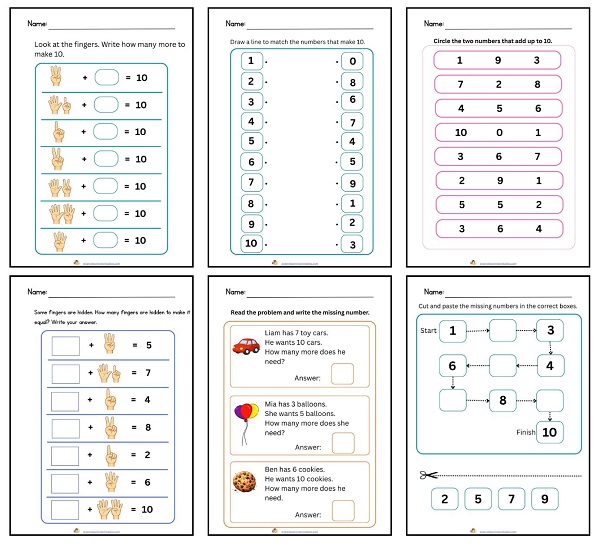
Stage 3 of our Kindergarten Mind Computation Using Fingers program introduces one of the most important concepts in early mathematics—making 10. Once children master number bonds to 10, addition and subtraction become much easier because they begin to recognize number relationships instead of counting one by one.
What Are Number Bonds to 10?
A number bond shows how two parts combine to make a whole. In this lesson, the whole number is 10.
Examples include:
- 0 + 10 = 10
- 1 + 9 = 10
- 2 + 8 = 10
- 3 + 7 = 10
- 4 + 6 = 10
- 5 + 5 = 10
Children learn that although the numbers change, the total remains the same.
Using both hands provides a natural and visual way to understand these relationships.
Why Are Number Bonds to 10 Important?
Learning Number Bonds to 10 Worksheets helps children:
- Build strong number sense
- Develop mental computation skills
- Understand addition and subtraction
- Recognize number patterns
- Improve problem-solving ability
- Increase confidence in mathematics
Instead of counting every object, children begin to think about numbers flexibly.
Why Teach Number Bonds Using Fingers?
Young learners understand math best when they can see and touch quantities.
Since both hands have 10 fingers, they become an excellent learning tool.
For example:
Show 7 fingers.
Ask:
How many more fingers make 10?
Answer:
3
After repeated practice, children answer immediately without counting.
This is the first step toward true mental math.
What Is Included in These Number Bonds to 10 Worksheets?
This printable worksheet set includes engaging activities that keep learning fun.
Complete the Number Bond
Children fill in the missing number.
Example:
7 + ___ = 10
Match the Number Partners
Students connect numbers that work together to make 10.
Example:
- 1 → 9
- 2 → 8
- 3 → 7
- 4 → 6
- 5 → 5
Draw the Missing Fingers
Children draw the remaining fingers needed to make a total of 10.
Hidden Fingers Challenge
Some fingers are hidden.
Students determine how many are missing.
This activity strengthens visualization and logical thinking.
Circle the Pair That Makes 10
Students identify the correct combinations from several choices.
Fill in the Blank
Examples:
- 6 + ___ = 10
- ___ + 8 = 10
- 3 + ___ = 10
Number Bond Word Problems
Simple real-life situations encourage children to apply what they have learned.
Example:
Emma has 6 balloons.
She wants 10 balloons.
How many more balloons does she need?
Answer:
4
Learning Objectives
After completing these Number Bonds to 10 Worksheets, children will be able to:
- Identify number partners that make 10
- Understand part-part-whole relationships
- Use finger math effectively
- Solve simple addition problems
- Prepare for subtraction strategies
- Build a strong foundation for mental computation
Stage 3 of the Kindergarten Mind Computation Program
Our finger math curriculum follows a step-by-step progression.
Stage 1: Number Recognition and Finger Counting
Children first learn to:
- Count from 1–10
- Recognize finger patterns
- Match quantities with numbers
Practice using:
- Finger Counting Worksheets
- Counting Worksheets
- Number Matching Worksheets
Stage 2: Number Bonds to 5
Children then learn:
- Number partners that make 5
- Missing numbers
- Finger visualization
- Basic number relationships
Mastering this stage prepares children for working with 10.
Stage 3: Number Bonds to 10
(Current Lesson)
Children now learn:
- Number partners to 10
- Missing numbers
- Making 10 strategy
- Visual mental computation
This stage is one of the strongest predictors of future success in addition and subtraction.
Coming Next
Continue your child’s learning journey with:
- Stage 4: Finger Addition Within 10
- Stage 5: Counting On Strategy
- Stage 6: Finger Subtraction
- Stage 7: Doubles and Near Doubles
- Stage 8: Make Ten Strategy
- Stage 9: Hidden Fingers Game
- Stage 10: Mental Computation Without Fingers
Each stage builds upon the previous lesson to develop fast and accurate mental math skills.
Fun Activities for Parents and Teachers
Learning becomes more effective when children play.
Try these activities:
- Complete the Hand
- Hidden Fingers Game
- Flash Card Challenge
- Number Bond Race
- Draw the Missing Fingers
- Five-Minute Daily Practice
Consistent practice leads to automatic recall of number bonds.
Related Learning Resources
You may also enjoy these printable activities:
Numbers & Counting
- Numbers & Counting
- Counting Worksheets
- Number Matching Worksheets
- Number Bonds Worksheets
Writing Practice
- Number Tracing Worksheets
- Tracing Numbers 1–5
- Tracing Numbers 6–10
Addition Practice
- Addition Worksheets
- Kindergarten Addition Worksheets
- Adding with Pictures Worksheets
- Beginning Addition Worksheets
Subtraction Practice
- Subtraction Worksheets
- Picture Subtraction Activities
Frequently Asked Questions
What age should children learn number bonds to 10?
Most children between 4 and 6 years old can begin learning number bonds through games, finger activities, and printable worksheets.
Why are number bonds better than memorizing addition facts?
Number bonds help children understand relationships between numbers instead of simply memorizing answers. This deeper understanding improves long-term mathematical thinking.
How do finger activities improve mental computation?
Children first use real fingers, then visualize finger patterns mentally. Eventually, they solve problems without physically counting, making calculations faster and more accurate.
These Number Bonds to 10 Worksheets are an essential step in developing strong early math skills. Through finger math, visual learning, and engaging activities, children discover that numbers can be combined in different ways to make 10.
Once this concept becomes automatic, students are ready for addition strategies, subtraction, and advanced mental computation. Daily practice with fun printable worksheets helps build confidence, speed, and a lifelong love of mathematics.

Will Gab is the creator of Arianne Learning Printables. He started designing worksheets to support his daughter’s kindergarten learning journey. What began as a personal project has grown into a free educational resource for parents, teachers, and children around the world.
Will Gab continues to develop printable activities based on the skills young children need as they prepare for kindergarten and early elementary school.
Related Worksheets:
 Number Bonds to 5 Worksheets for Kindergarten (Free Printable Finger Math Activities)
 Finger Counting Worksheets for Kindergarten (Free Printable)
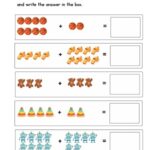 Beginning Addition Worksheets – Count and Add Pictures | Preschool & Early Elementary Math
 Let’s Practice Subtraction: A Beginner’s Guide Using Pictures for Kids
 Master Phonics with Free CVC Short E Words Worksheets
 Alphabet Flash Card Fruit Themed Learning: Why “V is for Vanilla” is Perfect for Kids
Pingback: Kindergarten Mind Computation Using Fingers: A Complete Step-by-Step Guide - Arianne Learning Printables Kindergarten Mind Computation Using Fingers (Free Worksheets & Step-by-Step Guide)
Pingback: Counting On Worksheets for Kindergarten (Addition Within 10 Using Fingers) - Arianne Learning Printables Counting On Worksheets for Kindergarten (Addition Within 10 Using Fingers)