
The letter C represents a significant shift in a child’s handwriting journey. While early letters often rely on rigid vertical and horizontal strokes, the uppercase and lowercase “C” introduce the concept of pure, continuous curved motion.
Because there are no straight lines or sharp angles to rely on, mastering this letter is a foundational exercise for developing fluid fine motor skills and better pencil control. Transitioning from “stop-and-go” movements to a smooth, sweeping arc helps preschoolers build the muscle memory needed for more complex cursive and print letters later on.
After learning letters like free letter b tracing worksheet for preschool printable pdf, children are ready to practice continuous curves.
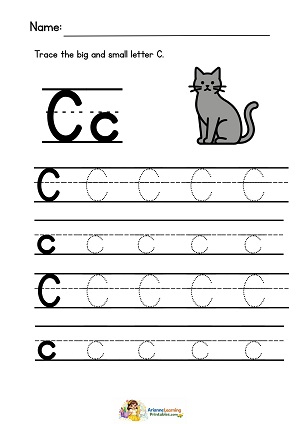
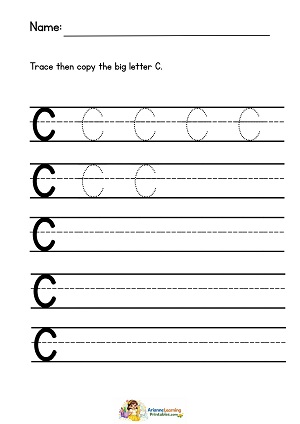
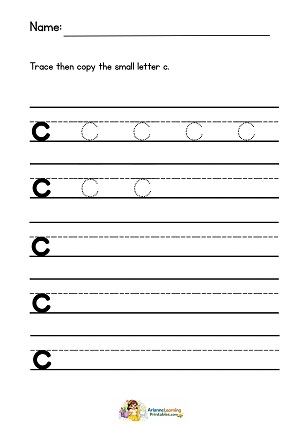
Why Practice Letter C Tracing?
Many parents and educators begin with linear letters (like L, T, or H) because they are easier for small hands to stabilize. However, introducing the letter C early provides several developmental benefits:
- Improved Hand-Eye Coordination: Navigating a semi-circle requires consistent visual tracking.
- Dexterity Boost: It teaches children how to pivot their wrist smoothly rather than moving their entire arm.
- Foundational Shape: The “C” shape is the “base” for many other letters, including O, G, Q, and D.
Moving Beyond Straight Lines
After a child has gained confidence with simpler strokes—perhaps by using a free letter B tracing worksheet for preschool (printable PDF)—they are developmentally ready to tackle continuous curves.
While the letter B combines a straight spine with curves, the letter C removes the “safety net” of that straight line. This challenge encourages children to focus on the flow of the stroke from start to finish.
Pro-Tip for Teaching: Encourage your student to think of the letter C as a “moon shape” or a “cookie with a bite out of it.” Using descriptive imagery makes the transition to curved motions much more engaging for young learners!
🎯 What Makes Letter C Unique?
The letter C focuses on:
- Continuous curved motion
- Smooth pencil control
- Shape consistency
This prepares children for letters like O, G, and Q.
🧠 Skills Your Child Will Develop
- Smooth hand movement
- Curve control
- Visual recognition of curved shapes
You can pair this with fun learning like cvc-short-a-sentences-fluency-read-highlight-color-worksheets-free-printable.
✍️ How to Teach Letter C
Step 1: Demonstrate the Curve
Show how to draw a “half circle”
Step 2: Big Air Movements
Have your child draw large C shapes in the air.
Step 3: Trace Slowly
Encourage tracing in one smooth motion without stopping.
Step 4: Repeat for Muscle Memory
🎮 Activity: “Draw Big C Shapes”
- Use paper or a board
- Let your child draw large curves
👉 Builds confidence before small tracing
✏️ Tracing Tips
- Avoid lifting the pencil
- Keep motion smooth
- Start from the top
⚠️ Common Mistakes
- Sharp edges instead of curves
- Stopping midway
- Uneven shape
📊 Difficulty Level
Intermediate
🔗 What Comes Next?
Move forward to:
📥 Download Your Free Letter C Worksheet

Will Gab is the creator of Arianne Learning Printables. He started designing worksheets to support his daughter’s kindergarten learning journey. What began as a personal project has grown into a free educational resource for parents, teachers, and children around the world.
Will Gab continues to develop printable activities based on the skills young children need as they prepare for kindergarten and early elementary school.
Related Worksheets:
 How to Teach Letter A Tracing (Free Printable Worksheet for Preschoolers)
 How to Teach Letter F Tracing (Free Printable Worksheet for Preschoolers)
 How to Teach Letter G Tracing (Free Printable Worksheet for Preschoolers)
 How to Teach Letter Q Tracing (Free Printable Worksheet for Preschoolers)
 How to Teach Letter R Tracing (Free Printable Worksheet for Preschoolers)
 How to Teach Letter Recognition: A Complete Guide for Parents and Teachers
Pingback: Letter D Tracing Worksheet (Uppercase and Lowercase D) Printable - Arianne Learning Printables Letter D Tracing Worksheet for Preschool (Free Printable + Guide)
Pingback: How to Teach Letter G Tracing (Free Printable Worksheet for Preschoolers) - Arianne Learning Printables Letter G Tracing Worksheet (Free Printable + Curve Practice)
Pingback: How to Teach Letter O Tracing (Free Printable Worksheet for Preschoolers) - Arianne Learning Printables Letter O Tracing Worksheet for Preschool (Free Printable + Tips)
Pingback: Alphabet Letter Tracing Worksheets A–Z - Arianne Learning Printables Alphabet Letter Tracing Worksheets A-Z | Free Printable Alphabet Practice