
Memorizing a poem can seem like a big task for a kindergarten child. Young learners may understand the words when they hear them but struggle to remember the correct order. Some children become distracted after a few lines, while others feel nervous when asked to recite in front of people.
The good news is that poem memorization does not have to feel like a test. When a poem is divided into small parts and connected to pictures, actions, rhythm and meaning, children can learn it gradually and confidently.
The goal is not simply to repeat words perfectly. A good poetry activity also helps children enjoy language, hear patterns, speak clearly and express ideas with feeling.
Choose a Suitable Poem
Begin with a poem that matches your child’s age, interests and language ability. A short poem with a clear rhythm is usually easier to remember than a long passage with unfamiliar vocabulary.
Look for a poem with:
- Four to eight short lines for a beginner
- Familiar words or ideas
- A predictable rhythm
- Repeated phrases
- Simple rhymes
- Images the child can picture
- A topic the child enjoys
A poem about animals, weather, family, play or nature may feel more inviting than an abstract poem. If the poem is assigned by a teacher, read it first and identify any words your child may not understand.
Explain the Poem Before Memorizing It
Children remember words more easily when those words have meaning. Read the entire poem aloud at a natural pace. Then talk briefly about what happens in it.
Ask simple questions:
- Who or what is the poem about?
- What happens first?
- What picture do you imagine?
- Is the poem happy, funny, calm or exciting?
- Are there any words you do not know?
Explain unfamiliar words with examples, pictures or objects. Avoid turning this discussion into a long lesson. The purpose is to help the child form a mental picture of the poem.
Read the Poem Aloud With Expression
Children learn by hearing how language sounds. Read the poem slowly and clearly while using appropriate expression.
Pause at punctuation, emphasize important words and allow the rhythm to be heard. If the poem is playful, let your voice sound playful. If it is gentle, use a calm voice.
Read the poem a second time and invite your child to listen for repeated or rhyming words. Hearing the complete poem several times gives the child a sense of its structure before individual lines are practised.
Divide the Poem Into Small Parts
Do not ask a kindergarten child to memorize the entire poem at once. Divide it into manageable sections.
For a short poem, practise one line at a time. For a longer poem, use two closely connected lines as one section.
Try this sequence:
- Read the first line aloud.
- Ask your child to repeat it with you.
- Say it together two or three times.
- Let your child try it independently.
- Add the next line.
- Recite both lines together.
Continue only while your child remains attentive. It is fine to learn one or two lines and stop for the day.
Use the Echo Method
Echo reading is simple and effective for young children. The adult says a line, and the child repeats it in the same way.
Begin with a complete line. If the line is difficult, break it into shorter phrases.
For example:
Adult: “The little bird”
Child: “The little bird”
Adult: “sings in the tree”
Child: “sings in the tree”
Then join the phrases: “The little bird sings in the tree.”
Keep the activity light. Try a whispering voice, a cheerful voice or a slow giant voice. Voice changes can make repetition enjoyable without changing the words.
Add Simple Actions
Movement gives children another way to remember each line. Create one clear action for an important word or idea.
If a poem mentions a bird, move your hands like wings. If it mentions rain, wiggle your fingers downward. If someone sleeps, rest your head on your hands.
Use the same actions every time. Consistent movements become memory clues. If your child forgets a word, begin the action and allow them time to recall it.
Avoid adding too many complicated gestures. Actions should support the poem rather than distract from speaking.
Draw a Picture for Each Line
Visual prompts are especially helpful when children can understand a poem but cannot remember the sequence.
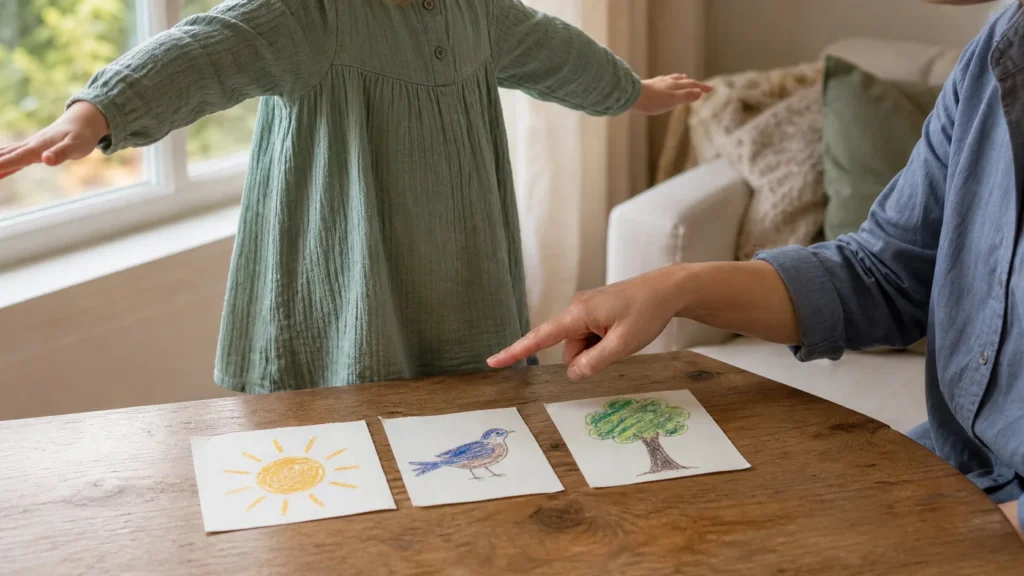
Draw one simple picture for each line or section. The pictures do not need to be detailed. A sun, cloud, tree, bird or stick figure may be enough.
Place the pictures in order and recite the poem while pointing to them. When the poem becomes familiar, turn over one picture at a time. Ask your child to say the missing line from memory.
You can also let your child create the pictures. Drawing encourages them to think about the meaning of each part.
Activities such as pre-writing line practice can support the pencil control children use when making simple visual reminder cards.
Notice Rhymes and Repeated Words
Rhymes make the ending of a line easier to predict. Help your child listen for words that sound alike.
Say the rhyming pair slowly and ask, “What do you notice about these words?” Repeat the lines and emphasize the matching endings.
Circle or highlight repeated words if the child is beginning to recognize print. A familiar repeated phrase can become an anchor that helps organize the rest of the poem.
For extra listening practice, use the CVC Short-A Sentences Worksheets to help early readers notice simple sound patterns in words and sentences.
Practise in Short Daily Sessions
Kindergarten children usually benefit from brief, regular practice. Five to ten minutes once or twice a day may be more productive than one long session.
A simple practice schedule could be:
- Day 1: Read the poem and discuss its meaning.
- Day 2: Learn the first one or two lines.
- Day 3: Review and add the next section.
- Day 4: Practise the entire poem using pictures and actions.
- Day 5: Reduce the prompts and practise reciting for someone.
Adjust the schedule to the poem and the child. Some children need more repetition, and that is normal.
Review Old Lines Before Adding New Ones
At the beginning of each session, ask your child to recite what they already know. Give a small clue if needed.
Once the familiar section is comfortable, add one new line. Finish by returning to the beginning and joining the old and new parts.
This repeated joining helps the child remember the order. Learning separate lines without connecting them can make transitions difficult during a complete recitation.
Gradually Remove the Prompts
Pictures, gestures and adult support are useful while the poem is being learned. They should be reduced slowly as the child gains confidence.
Try this progression:
- Adult and child recite together with pictures and actions.
- Child leads while the adult quietly joins difficult words.
- Child recites with pictures only.
- Some pictures are removed.
- Child recites without pictures while keeping small gestures.
- Child recites independently.
Do not remove every support suddenly. If the child becomes stuck, return to an earlier stage and try again later.
Turn Practice Into a Game
Repetition is necessary, but it does not need to feel repetitive. Change the way the poem is practised while keeping the words accurate.
Try these ideas:
Pass the Line
The adult says the first line, the child says the second, and you continue taking turns. Switch roles on the next round.
Missing Word
Recite a familiar line but pause before one important word. Let your child supply the missing word.
Picture Mix-Up
Mix the picture cards and ask your child to place them in the poem’s correct order.
Toy Audience
Arrange stuffed toys or dolls as an audience. Let your child perform for them before reciting for people.
Quiet and Loud
Say one line quietly and the next at a normal speaking volume. Avoid shouting, which can make the words unclear.
Help Your Child Speak Clearly
Memorization and presentation are related but different skills. First help your child remember the words. Then work gently on speaking clearly.
Encourage your child to:
- Stand comfortably
- Look forward occasionally
- Speak loudly enough to be heard
- Say each word clearly
- Pause between lines when appropriate
- Use natural expression
- Keep gestures simple
Do not correct posture, volume, pronunciation and memory all at the same time. Choose one small presentation goal for each practice.
Prepare for Reciting in Front of Others
A child who can recite comfortably at home may forget words when facing an audience. Build confidence gradually.
Begin with a toy audience. Next, recite for one trusted family member. Later, invite two or three people to listen.
Re-create the likely performance situation. Have your child stand in one place, say the title if required, recite the poem and finish with a small pause.
Remind your child that forgetting one word does not ruin the performance. Teach a recovery plan: pause, take a breath, remember the picture or action, and continue.
What to Do When Your Child Forgets a Line
Wait for a few seconds before supplying the answer. The child may be able to retrieve it independently.
If help is needed, give the smallest possible clue:
- Show the matching picture.
- Begin the action.
- Say the first sound or word.
- Ask what happens next in the poem.
Avoid restarting the entire poem after every mistake. Continue from the forgotten line, then review the transition later.
Avoid Pressure and Over-Correction
Poetry should strengthen language and confidence, not create fear. If your child is tired or frustrated, stop and return later.
Avoid comments such as “You already learned this” or “You keep forgetting.” Instead, identify what is going well:
- “You remembered the first four lines by yourself.”
- “The picture helped you find the next part.”
- “You spoke slowly and clearly that time.”
- “You kept going after you forgot a word.”
Specific encouragement teaches children which strategies are helping them improve.
Common Mistakes to Avoid
Starting With a Poem That Is Too Long
A long poem can overwhelm a beginner. Start with a short success and gradually increase the length.
Repeating Without Understanding
Words are harder to remember when the child does not understand the poem. Discuss its meaning first.
Practising for Too Long
Long sessions can lead to guessing, silliness or resistance. Stop while attention is still strong.
Correcting Every Attempt
Allow the child to finish a section before discussing a mistake. Frequent interruption can break concentration.
Waiting Until the Last Day
Short practice across several days is calmer and gives the poem time to become familiar.
Expecting a Perfect Performance
Kindergarten children are developing memory, language and confidence. Improvement matters more than perfection.
Frequently Asked Questions
How long should a kindergarten poem be?
For a child new to memorization, four to eight short lines is a reasonable starting point. A familiar child may manage more, especially when the poem has repetition and rhyme.
How many times should a child repeat each line?
There is no fixed number. Two or three careful repetitions may be enough before trying independently. Continue only while the child is still listening and speaking thoughtfully.
Should my child read the poem while memorizing it?
If your child can read the words comfortably, printed text can help. If decoding is difficult, let the adult read while the child learns through listening, pictures and actions.
What if my child changes some words?
First check whether the child understands the line. Repeat the correct version slowly and practise the difficult phrase. Avoid making the error feel serious.
Are actions allowed during a recitation?
Simple gestures can support meaning and confidence unless the teacher has given different instructions. Keep the actions natural and consistent.
What if my child is afraid to perform?
Use a gradual audience: toys, one adult, family members and then a larger group. Praise brave attempts and avoid forcing a performance when the child is highly distressed.
Final Thoughts
Helping a kindergartener memorize a poem works best when the experience is broken into small, meaningful steps. Choose a suitable poem, explain its meaning, teach one line at a time and connect the words to pictures, actions, rhythm and rhyme.
Keep practice short, review often and remove prompts gradually. Most importantly, protect the child’s confidence. A warm and playful routine can turn memorization from a stressful task into an enjoyable experience with language.
When children understand the poem and feel successful while learning it, they are more likely to recite with clear speech, expression and pride.

Will Gab is the creator of Arianne Learning Printables. He started designing worksheets to support his daughter’s kindergarten learning journey. What began as a personal project has grown into a free educational resource for parents, teachers, and children around the world.
Will Gab continues to develop printable activities based on the skills young children need as they prepare for kindergarten and early elementary school.
Related Worksheets:
 Best Worksheets for Preschool: A Complete Guide for Parents and Teachers
 How to Teach Counting to Preschoolers: Fun and Easy Learning Guide
 Benefits of Tracing Worksheets for Preschool
 How to Prepare My Child to Be Good at Math: 15 Simple Secrets Every Parent Should Know
 Missing Addends Within 10: A Kindergarten Guide and Free Worksheet
 Addition Word Problems Within 10: Kindergarten Activities and Free Worksheet