
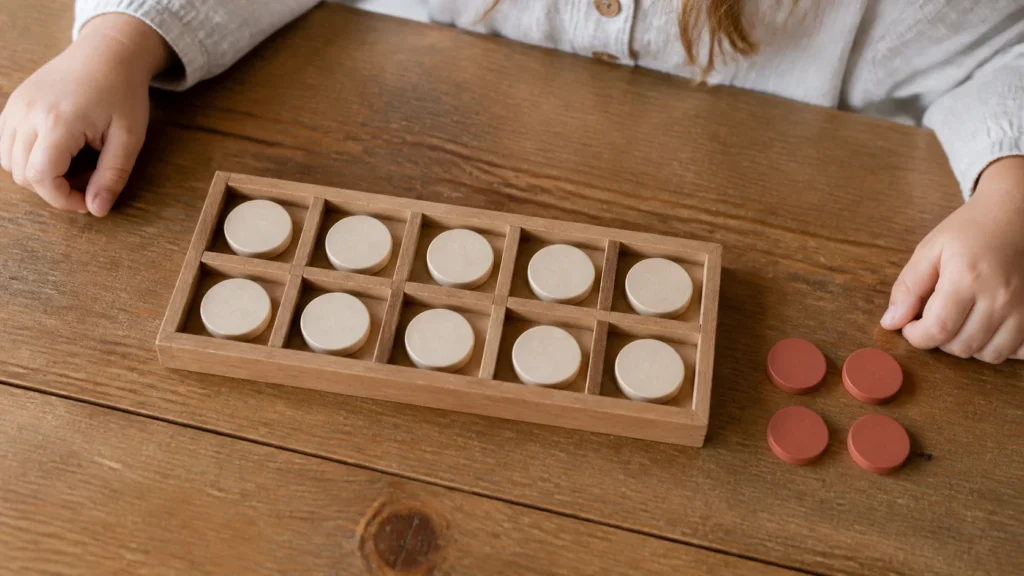
Teen numbers can be confusing because their spoken names do not always make the tens-and-ones structure obvious. A ten-frame helps children see that every number from 11 through 19 is one complete ten plus some extra ones.
For example, 14 is not just a number to recite after 13. It is one group of ten and four more. Building that structure prepares children for place value, addition, and subtraction.
What Are Teen Numbers?
Teen numbers are 11 through 19. Each contains one ten and a number of ones:
- 11 is 10 and 1 more.
- 14 is 10 and 4 more.
- 17 is 10 and 7 more.
- 19 is 10 and 9 more.
The number 10 itself has one ten and zero extra ones. The number 20 begins a new group with two tens.
Build a Full Ten-Frame First
Give the child a ten-frame and counters. Fill every space, counting from 1 to 10. Explain that the full frame is one complete ten.
Place a second empty frame or blank workspace beside it. Add four counters and say, “One ten and four ones make fourteen.” Touch the full frame once for the ten, then count the extra counters: eleven, twelve, thirteen, fourteen.
Keep the ten-frame full. If children scatter all fourteen counters together, the structure becomes harder to see.
Connect the Model to Numerals
Write 14 beside the counters. Point to the digit 1 and say it represents one group of ten. Point to the digit 4 and say it represents four ones.
Use a simple sentence frame:
_ is one ten and _ ones.
Repeat with several numbers. Ask children to build the number before completing the sentence.
Compare Teen Numbers
Once children understand one ten and extra ones, compare two teen numbers such as 13 and 18. Both contain one ten, so compare the extra ones. Eight ones are more than three ones, so 18 is greater than 13.
This links naturally to the site’s comparing-numbers lesson and strengthens place-value reasoning.
Download the Free Teen Numbers Worksheet
Easy Teen-Number Games
Build My Number
Say a teen number and ask the child to fill one ten-frame and add the correct number of extra counters.
Mystery Number
Show a full ten-frame and hide some extra counters under a cup. Give a clue such as, “My number is greater than 14 but less than 17.”
Match the Cards
Prepare numeral cards from 11 to 19 and picture cards showing a full ten-frame with extra dots. Ask the child to match each model to its numeral.
Teen-Number Hunt
Look for teen numbers on calendars, page numbers, house numbers, or classroom materials. Ask the child to describe each as one ten and some ones.
Common Difficulties
Children sometimes reverse 14 and 41. Rebuild 14 and emphasize that it has one ten, so the digit 1 comes first. Forty-one would contain four tens and one one.
Some children recount every counter from one. Encourage them to recognize the full frame as ten and count on from there.
If the names thirteen and fifteen cause confusion, keep returning to the visual model. The quantity is more dependable than the irregular word.
Frequently Asked Questions
Should kindergarten children use place-value vocabulary?
Yes, in simple form. Regularly saying “one ten and four ones” gives meaning to the digits without requiring abstract worksheets first.
Why stop at 19?
Numbers 11–19 share the structure of one ten and extra ones. Twenty introduces two complete tens and is a useful next lesson.
Can I use two ten-frames?
Yes. Keep the first frame full and place extra counters in the second. This visually preserves the group of ten.
Final Thoughts
Teen numbers become much clearer when children can see one complete ten and the leftover ones. Build the number, describe its parts, connect the model to the numeral, and then use the worksheet for independent practice.

Will Gab is the creator of Arianne Learning Printables. He started designing worksheets to support his daughter’s kindergarten learning journey. What began as a personal project has grown into a free educational resource for parents, teachers, and children around the world.
Will Gab continues to develop printable activities based on the skills young children need as they prepare for kindergarten and early elementary school.
Related Worksheets:
 Beginning Addition Worksheets – Count and Add Pictures | Preschool & Early Elementary Math
 Let’s Practice Subtraction: A Beginner’s Guide Using Pictures for Kids
 Number Bonds to 10 Worksheets for Kindergarten (Free Printable Finger Math Activities)
 Finger Addition Worksheets Within 5 and 10 for Kindergarten
 Make Ten Strategy for Kindergarten: A Simple Finger Math Guide
 Number Bonds to 10 for Kindergarten: Easy Activities and Free Worksheet