
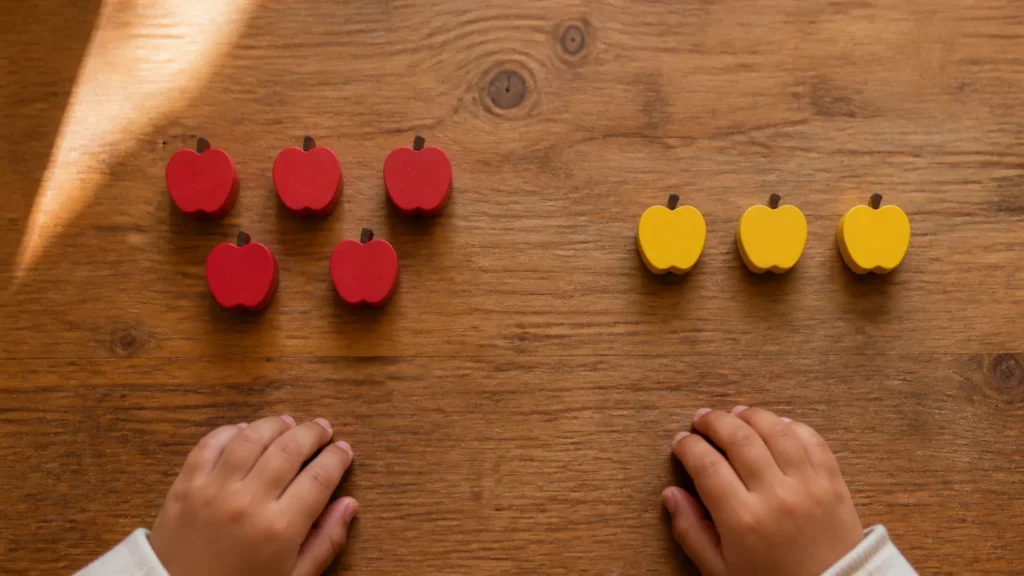
Word problems help children connect addition to everyday situations. Instead of seeing only 5 + 3, a child imagines five apples and three more apples joining the group. That small story gives the numbers meaning.
Kindergarten word problems should be short, familiar, and easy to act out. Begin with totals within 10 and use objects before expecting a written equation.
What Is an Addition Word Problem?
An addition word problem describes two amounts being combined. For example: “Mia has five blocks. Her friend gives her three more blocks. How many blocks does Mia have now?”
The child needs to identify the first group, the group being added, and the total. Reading ability should not become the main difficulty, so adults can read the question aloud.
Use the Act-Draw-Write Method
Teach one repeatable routine:
- Act it out. Build both groups with counters or toys.
- Draw it. Make a simple circle or mark for each object.
- Write it. Record the matching addition equation.
For five apples and three more, the child builds 5 and 3, draws eight marks, and records 5 + 3 = 8.
Questions to Ask
Avoid telling the child which operation to use immediately. Ask:
- What happens in the story?
- What is the first group?
- How many more are added?
- Can you show it with counters?
- What question are we trying to answer?
Words such as “more,” “altogether,” and “in all” can be helpful clues, but understanding the action in the story is more reliable than memorizing keywords.
Model a Problem Together
Read: “There are four ducks in a pond. Two more ducks join them. How many ducks are in the pond now?”
Place four counters on the table, then move two more beside them. Count the complete group. Say, “Four and two make six,” and write 4 + 2 = 6.
Ask the child to explain the answer in a sentence: “There are six ducks now.” This checks that the answer belongs to the story.
Download the Free Addition Word Problems Worksheet
Make Your Own Stories
Use objects your child already enjoys. Toy cars can drive into a garage, animals can join a farm, and crayons can be added to a box. Let the child choose the objects and invent the names.
Try these oral prompts:
- Two birds sit on a fence. Three more arrive. How many birds are there?
- A child has six stickers and receives two more. How many stickers are there now?
- Four shells are in a bucket. One more shell is added. How many are in the bucket?
Keep objects visible until the child can explain the solution without them.
Common Mistakes
Some children combine the wrong numbers because they listen for keywords without understanding the story. Ask them to retell the situation in their own words.
Other children write a correct total but reverse the equation. Return to the action: start with the first group, add the second group, and then count the whole.
If drawing takes too long, let the child use quick dots or tally marks. The picture is a thinking tool, not an art project.
Frequently Asked Questions
Can children solve word problems before they can read?
Yes. Read the story aloud and let the child act it out. Mathematical reasoning can develop independently of reading fluency.
How many problems should we do at once?
Two to four thoughtful problems are enough for one session. Ask the child to explain each answer.
When should children stop using counters?
Do not rush to remove them. Children naturally use fewer objects as mental strategies become stronger.
Final Thoughts
Addition stories make equations useful and memorable. Let children act, draw, and write each situation in that order. Short conversations about how the groups change will build stronger reasoning than a long page of disconnected sums.

Will Gab is the creator of Arianne Learning Printables. He started designing worksheets to support his daughter’s kindergarten learning journey. What began as a personal project has grown into a free educational resource for parents, teachers, and children around the world.
Will Gab continues to develop printable activities based on the skills young children need as they prepare for kindergarten and early elementary school.
Related Worksheets:
 Best Worksheets for Preschool: A Complete Guide for Parents and Teachers
 How to Teach Counting to Preschoolers: Fun and Easy Learning Guide
 Benefits of Tracing Worksheets for Preschool
 How to Prepare My Child to Be Good at Math: 15 Simple Secrets Every Parent Should Know
 Missing Addends Within 10: A Kindergarten Guide and Free Worksheet
 How to Use Printable Worksheets Without Overwhelming Your Kindergartener