
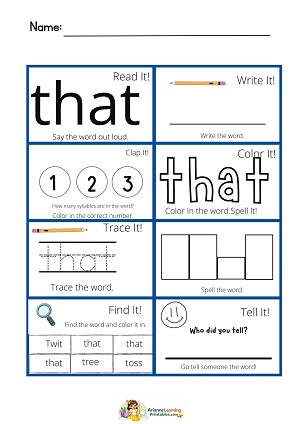
“That” is a powerful early-reading word because children use it to point, ask questions, and add information to a sentence. This free sight word “that” worksheet combines handwriting and word recognition with meaningful spoken practice.
What the Sight Word “that” Means
Young learners first meet “that” when pointing to something farther away: “That is my bag.” They will also see it joining ideas in stories, as in “I know that song.” Practicing both patterns prevents the word from becoming a flash-card answer with no meaning.
Learning Objective
The child will recognize “that” in print, form all four letters in order, distinguish it from similar words, and use it naturally in a complete sentence.
How to Use This Worksheet
Read the large word aloud. Tap each letter while spelling t-h-a-t, trace the model, copy it independently, and search the word grid carefully. Ask for one pointing sentence before ending the page.
- Read: Say the word naturally, not letter by letter.
- Trace and write: Use a comfortable pencil grip and check the letter order.
- Color and spell: Name each letter while coloring or building the word.
- Find and tell: Locate the exact word and use it in speech.
Teaching Observation
Watch whether the child reads the entire word or stops after “th.” A reader who guesses “the” needs practice sliding a finger beneath all four letters and noticing the final “at” chunk.
Five Child-Friendly Sentences
- That kite is very high.
- I know that song.
- Please bring me that cup.
- She said that we could play.
- Is that your coat?
Hands-On Practice
Put one object near the child and another across the room. Take turns saying “this” for the near object and “that” for the farther object. Then place the printed word beside the correct object.
A Common Mistake to Watch For
“That” is often confused with “the” because both begin with th. Teach the child to look through the end of the word. Box the final “at,” read it, and blend the complete word again.
Quick Mastery Check
Mix “that,” “the,” and “this” on three cards. The child should select “that,” read it immediately, and make a correct sentence about a farther object.
Build a Short Reading Routine
Use the page for five to ten minutes, then revisit the word in a book or classroom message. Short, spaced practice is more useful than completing many repetitions at once. Explore the sight word worksheet collection for the next word, the phonics and reading hub for related literacy activities, and the writing and tracing hub for extra handwriting practice.
Download the Free Sight Word “that” Worksheet
Print the PDF on A4 or Letter paper at actual size. Children can use crayons for the coloring activity and a pencil for tracing and independent writing. Reprint the page only when the learner needs another short review.
Learning Objectives for the Sight Word “that”
- Recognize and read “that” in a new sentence.
- Use “that” when identifying something farther away.
- Distinguish “that” from “this” through meaning.
Teaching Observation
Children often memorize “that” but interchange it with “this.” Put one object nearby and another across the table. Model “this cup” and “that ball,” then change the objects and positions. Connecting the word to distance makes the distinction memorable.
Point, Say, and Write
Ask the child to point to a distant object and say “That is a ___.” After three oral examples, the child writes one sentence independently and underlines “that.”
Review more high-frequency words in our sight-word worksheets hub.

Will Gab is the creator of Arianne Learning Printables. He started designing worksheets to support his daughter’s kindergarten learning journey. What began as a personal project has grown into a free educational resource for parents, teachers, and children around the world.
Will Gab continues to develop printable activities based on the skills young children need as they prepare for kindergarten and early elementary school.
Related Worksheets:
 Sight Word “And” Worksheet – Read, Write, Trace and Color Activity
 Sight Word “The” Worksheet – Read, Write, Trace and Color
 Sight Word “Him” Worksheet – Read, Trace, Write, and Color Printable Activity
 Sight Word “His” Worksheet – Read, Trace, Write, and Color Printable Activity
 Sight Word “if” Worksheet – Read, Write, Trace and Color Activity.
 Sight Word “in” Worksheet – Read, Write, Trace and Color