
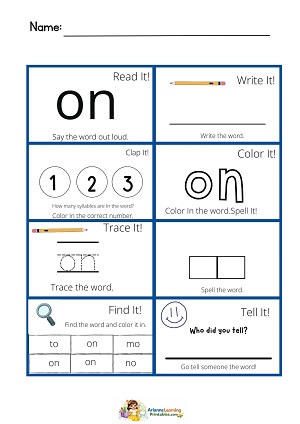
Learning sight words is an important step in early reading development. This Sight Word “on” worksheet helps preschool, kindergarten, and early elementary learners recognize, read, write, and remember this common word.
Sight words are frequently used words that children should recognize instantly without sounding them out. Words like the, you, and, is, and it appear often in books and everyday reading.
This printable worksheet allows children to practice the sight word “on” through a variety of engaging activities that build reading confidence and literacy skills.
Worksheet Activities
This sight word worksheet includes several fun learning activities:
Read It
Students read the word “on” and say it out loud to practice word recognition.
Write It
Children practice writing the word to improve handwriting and spelling.
Color It
Students color the sight word while focusing on letter recognition.
Trace It
Tracing dotted letters helps learners practice correct letter formation and develop fine motor skills.
Spell It
Children identify and spell each letter in the sight word.
Find It
Students search for the correct word among other words to strengthen recognition skills.
Tell It
Children practice using the word by sharing it with someone to reinforce learning.
Why Sight Words Are Important
Practicing sight words helps children:
• Improve reading fluency
• Recognize common words instantly
• Strengthen early literacy skills
• Build confidence in reading
• Develop stronger vocabulary
Sight word activities are especially helpful for preschool, kindergarten, and early elementary students learning to read.
Perfect For
This worksheet is great for:
• Preschool learning
• Kindergarten reading practice
• Early elementary literacy centers
• Homeschool activities
• Classroom reading practice
• Sight word intervention practice
Download the Worksheet
Download and print this Sight Word “on” worksheet to help children practice reading, writing, tracing, and recognizing this important word.
Practice the Sight Word “on” in Real Sentences
“On” often tells that something touches a surface. It can also name a day, device, or continuing action in simple texts.
Five Child-Friendly Examples
- The book is on the desk.
- We visit Grandma on Sunday.
- Turn on the light.
- Keep your shoes on.
- The show is on TV.
Hands-On Practice Game
Place a toy on, under, and in a box. The child follows a printed “on” card, then explains the toy’s position in a full sentence.
A Common Mix-Up to Watch For
Contrast “on” with “in” using real objects rather than definitions alone. Seeing the position makes the two short words easier to remember.
Quick Mastery Check
Ask the child to put an object “on” two different surfaces and read the direction card each time without adult help. For more early-reading practice, visit our phonics and reading collection.
Teaching Observation: Children Learn “on” Through Position
Children remember on more easily when they can see and perform its meaning. Place a toy on a box, under the box, and beside the box. Ask, “Where is the toy?” Move an on word card beside the correct scene so the printed word is tied to a real position.
Learning Objectives for “on”
- Read on without relying on a picture.
- Blend /o/ and /n/ into the complete word.
- Use on correctly in a spoken sentence.
- Write the two letters in the correct order.
Common Mistakes and Corrections
Some children reverse the letters and read no. Build both words with letter cards and read them side by side. Others use in for every position; demonstrate the contrast with a toy inside a cup and then on top of it.
Mastery Check
Ask the child to select on from in, no, on, read it, place an object on something, say a sentence, and write the word from memory. Find more practice in the reading worksheets hub.
Continue Sight Word Learning
Use the sight word worksheet collection for spaced review, then visit the reading worksheets hub for phonics, fluency, and comprehension practice.

Will Gab is the creator of Arianne Learning Printables. He started designing worksheets to support his daughter’s kindergarten learning journey. What began as a personal project has grown into a free educational resource for parents, teachers, and children around the world.
Will Gab continues to develop printable activities based on the skills young children need as they prepare for kindergarten and early elementary school.
Related Worksheets:
 Sight Word “And” Worksheet – Read, Write, Trace and Color Activity
 Sight Word “The” Worksheet – Read, Write, Trace and Color
 Sight Word “Him” Worksheet – Read, Trace, Write, and Color Printable Activity
 Sight Word “His” Worksheet – Read, Trace, Write, and Color Printable Activity
 Sight Word “if” Worksheet – Read, Write, Trace and Color Activity.
 Sight Word “in” Worksheet – Read, Write, Trace and Color