
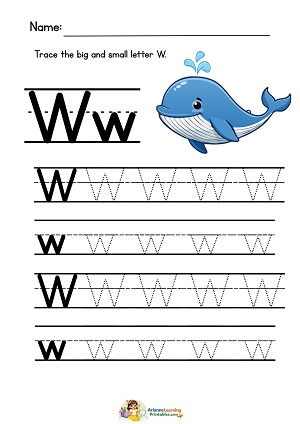
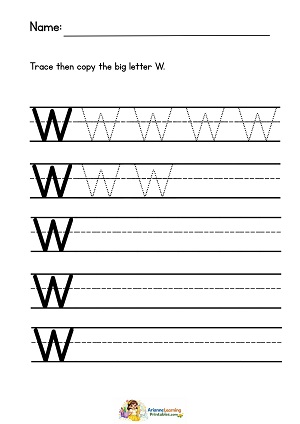
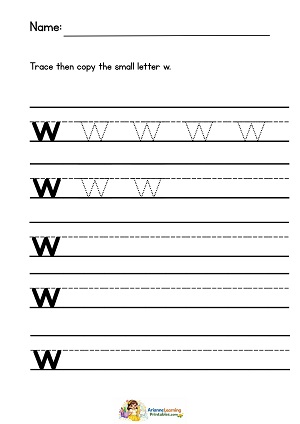
The letter W tracing worksheet is a fantastic way to challenge and engage young learners as they progress toward advanced penmanship. Often viewed as one of the more “exciting” letters to draw, the letter W helps children practice repeated diagonal movements and pattern recognition, making it an essential exercise for building handwriting stamina and mechanical flow.
The Mechanics of the W: Rhythm and Repetition
What makes the “W” unique is its repetitive structure. Since W is made of connected V shapes, it improves rhythm and stroke consistency by requiring the child to execute the same motion multiple times in a row. This creates a “rhythmic” writing experience that is different from single-stroke letters.
- Practicing Repeated Diagonals: The letter W requires four distinct diagonal strokes. This repetition is a workout for fine motor skills, helping children master the “slant” while ensuring that each subsequent line maintains the same angle and pressure as the first.
- Enhancing Pattern Recognition: When children learn to see the “W” as a series of connected “V” shapes, they are developing cognitive mapping skills. They begin to recognize patterns within the alphabet, realizing that complex letters are often just combinations of simpler ones they have already mastered.
- Building Stroke Consistency: To make a “W” look uniform, all four points (top and bottom) need to align. This helps children focus on proportionality, ensuring the letter doesn’t start large and end small, or “drift” off the writing line.
A Gateway to Handwriting Fluidity
Because the letter W is wide and requires more “travel” across the page than a letter like “I” or “T,” it helps children improve their spatial orientation. It teaches them how to manage the “real estate” of a horizontal line, a skill that is vital for spacing out words and sentences later on.
Instructional Tip: Use the “Mountain Range” analogy. Tell your students they are drawing two tall peaks side-by-side. Encourage them to keep the “valleys” (the bottom points) sharp and touching the baseline. This helps them maintain the sharp diagonal precision that defines the letter.
Key Developmental Benefits of Letter W Worksheets
| Skill Developed | Educational Impact |
| Bilateral Coordination | Improves the ability to track the pencil across a wider horizontal field. |
| Rhythmic Movement | Develops a steady “up-down-up-down” flow that prepares the hand for cursive. |
| Geometric Logic | Reinforces the concept of symmetry and mirrored angles. |
Strengthening Penmanship with Guided Tracing
Using a high-quality letter W tracing guide is particularly helpful for preventing “wobbly” lines. By following the dashed paths, children learn to maintain their momentum through all four strokes without pausing or lifting the pencil prematurely. This builds the handwriting endurance necessary for longer writing tasks in elementary school.
By mastering the repeated diagonal movements of the letter W, your student is doing more than just learning a letter; they are mastering the art of consistency and sequence. It is a powerful confidence-builder that shows them they can handle even the “widest” challenges in the alphabet.
Do you find that your students prefer to write the “W” as two separate “V”s, or do they enjoy the challenge of making it one continuous zigzag?
🎯 Focus Skills
- Repeated angles
- Pattern writing
- Stroke rhythm
✍️ Teaching Steps
- Draw down and up diagonally
- Repeat the motion twice
- Keep spacing even
🎮 Activity: “Wave Pattern Drawing”
Draw wave-like zigzags before tracing W.
⚠️ Common Mistakes
- Uneven peaks
- Incorrect spacing
- Slanted pattern
📊 Difficulty: Medium
🔗 Continue Learning
- letter-x-tracing-worksheet-uppercase-and-lowercase-x
- benefits-of-tracing-worksheets-for-preschool-and-kindergarten
Related Worksheets:
 How to Teach Letter A Tracing (Free Printable Worksheet for Preschoolers)
 How to Teach Letter B Tracing (Free Printable Worksheet for Preschoolers)
 How to Teach Letter E Tracing (Free Printable Worksheet for Preschoolers)
 How to Teach Letter F Tracing (Free Printable Worksheet for Preschoolers)
 How to Teach Letter P Tracing (Free Printable Worksheet for Preschoolers)
 How to Teach Letter Q Tracing (Free Printable Worksheet for Preschoolers)