
The word “for” helps children talk about a receiver, a purpose, a reason, or a length of time. This free sight word “for” worksheet gives kindergarten readers repeated practice while keeping the word connected to real speech and simple sentences.
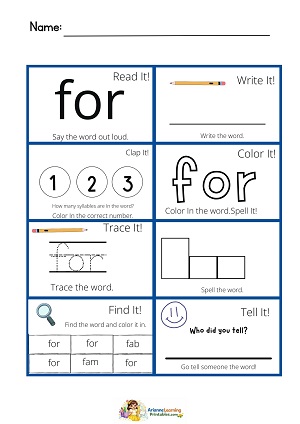
What the Sight Word “for” Means
Children hear “for” in phrases such as “for Mom,” “for lunch,” and “for ten minutes.” Showing these different uses helps them understand that the same printed word can do more than one job.
Learning Objective
The learner will read “for” automatically, spell and write its three letters in order, and use it correctly in a sentence that shows a receiver or purpose.
How to Use This Worksheet
Begin with a small pretend gift and ask who it is for. Read the worksheet word, trace it slowly, copy it without the model, and complete the find-it row. Return to the pretend gift for an oral sentence.
- Read: Say the word naturally, not letter by letter.
- Trace and write: Use a comfortable pencil grip and check the letter order.
- Color and spell: Name each letter while coloring or building the word.
- Find and tell: Locate the exact word and use it in speech.
Teaching Observation
Listen for a clear final r. Some children glance at the first two letters and say “from” or “of.” Encourage a left-to-right check and ask, “What letter finishes the word?”
Five Child-Friendly Sentences
- This card is for Dad.
- We waited for the bus.
- I wore boots for the rain.
- Read for ten minutes.
- She looked for her hat.
Hands-On Practice
Make simple gift tags for classroom objects. The child writes “for,” adds a person’s name, attaches the tag, and reads the complete phrase aloud: “This is for Ana.”
A Common Mistake to Watch For
“For” and “from” can look similar in a crowded word list. Highlight the ending: “for” stops with r, while “from” continues to o-m. Avoid asking children to memorize only the outline of the word.
Quick Mastery Check
Ask the child to read “for” on a card, write it from memory, and answer “Who is this for?” in a full sentence. Accurate performance on all three tasks shows useful mastery.
Build a Short Reading Routine
Use the page for five to ten minutes, then revisit the word in a book or classroom message. Short, spaced practice is more useful than completing many repetitions at once. Explore the sight word worksheet collection for the next word, the phonics and reading hub for related literacy activities, and the writing and tracing hub for extra handwriting practice.
Download the Free Sight Word “for” Worksheet
Print the PDF on A4 or Letter paper at actual size. Children can use crayons for the coloring activity and a pencil for tracing and independent writing. Reprint the page only when the learner needs another short review.

Will Gab is the creator of Arianne Learning Printables. He started designing worksheets to support his daughter’s kindergarten learning journey. What began as a personal project has grown into a free educational resource for parents, teachers, and children around the world.
Will Gab continues to develop printable activities based on the skills young children need as they prepare for kindergarten and early elementary school.
Related Worksheets:
 Sight Word “And” Worksheet – Read, Write, Trace and Color Activity
 Sight Word “The” Worksheet – Read, Write, Trace and Color
 Sight Word “His” Worksheet – Read, Trace, Write, and Color Printable Activity
 Sight Word “if” Worksheet – Read, Write, Trace and Color Activity.
 Sight Word “in” Worksheet – Read, Write, Trace and Color
 Sight Word “of” Worksheet – Read, Write, Trace and Color