
The letter S tracing worksheet is often regarded as a major milestone in a young learner’s handwriting journey. Unlike linear letters that rely on hard stops and straight paths, the letter S is one of the more advanced letters because it requires smooth transitions between upper and lower curves. This rhythmic, “snake-like” motion is essential for shifting a child’s writing from rigid mark-making to fluid, effortless penmanship.
Children who practiced curved letters like letter-g-tracing-worksheet-uppercase-lowercase-g may feel more confident learning S.
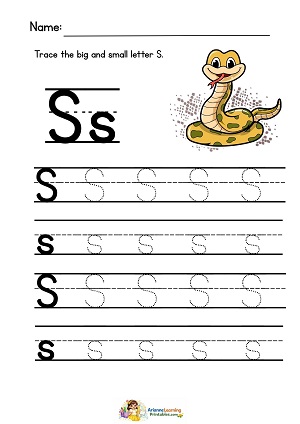
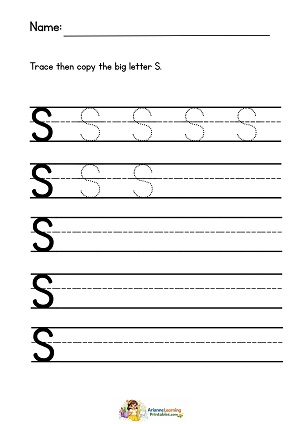
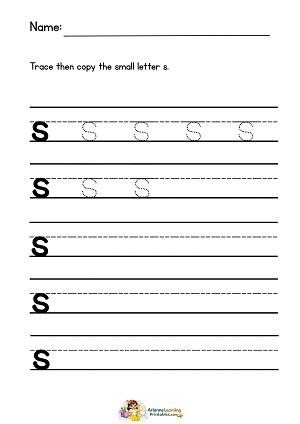
The Complexity of the S-Curve: Why It’s Advanced
In the world of fine motor development, the letter S represents a peak challenge in visual-motor integration. It is essentially two opposite-facing curves joined seamlessly in the middle, which requires a high level of cognitive and physical coordination.
- Practicing Smooth Transitions: To form a legible “S,” a child must navigate a “mid-point pivot.” They start with a counter-clockwise curve at the top and must transition—without lifting the pencil—into a clockwise curve at the bottom. This teaches the brain to “switch gears” mid-stroke.
- Improving Pencil Flow: Because the “S” is one continuous motion, it is the ultimate exercise for pencil flow. It encourages children to move their entire hand and wrist in harmony, rather than just using their fingers to “push” the pencil.
- Enhancing Movement Control: Maintaining the balance between the top and bottom loops of the “S” requires significant proprioception (an understanding of where the pencil is in space). This helps children learn how to scale their letters so they don’t become top-heavy or bottom-heavy.
A Gateway to Cursive and Artistic Skills
The fluid motion practiced during a letter S tracing activity is the closest a child gets to “pre-cursive” writing in the print alphabet. The ability to create a continuous, multi-directional curve is the exact skill needed for the loops and connections found in cursive script and advanced drawing.
Instructional Tip: Encourage children to visualize a “slithering snake” or a “winding road.” Using these metaphors helps them understand that the letter S shouldn’t have any sharp “elbows” or corners. The goal is a smooth, continuous sweep from start to finish.
Key Developmental Benefits of Letter S Worksheets
| Skill Feature | Educational Impact |
| Bilateral Fluidity | Connects left-brain planning with right-hand execution for complex curves. |
| Spatial Centering | Teaches the child to find the “invisible midline” where the curves swap directions. |
| Wrist Flexibility | Promotes a relaxed grip, which is essential for preventing hand fatigue during longer writing tasks. |
Strengthening Handwriting Through Guided Repetition
Using a high-quality letter S tracing guide is crucial because this is one of the most common letters for children to reverse. The guided dashed lines provide a “safety rail,” ensuring the child learns the correct orientation (starting to the right and curving back left) from the very beginning.
By mastering the movement control required for the letter S, your student isn’t just learning a character; they are unlocking a new level of physical dexterity. It may be a more advanced letter, but the grace and control it builds will benefit their handwriting across the entire alphabet.
Do you notice your students tend to struggle more with the initial turn at the top, or is it the “pivot” in the middle that usually causes them to pause?
🎯 Focus Skills
- Curve transitions
- Smooth pencil flow
- Hand movement control
✍️ Teaching Steps
- Start with the top curve
- Transition smoothly downward
- Finish with the lower curve
🎮 Activity: “Snake Drawing”
Let your child draw snake-like curves before tracing the letter S.
⚠️ Common Mistakes
- Sharp angles instead of curves
- Uneven top and bottom sections
- Stopping midway
📊 Difficulty: Hard
🔗 Continue Learning
- letter-t-tracing-worksheet-uppercase-and-lowercase-t
- benefits-of-tracing-worksheets-for-preschool-and-kindergarten

Will Gab is the creator of Arianne Learning Printables. He started designing worksheets to support his daughter’s kindergarten learning journey. What began as a personal project has grown into a free educational resource for parents, teachers, and children around the world.
Will Gab continues to develop printable activities based on the skills young children need as they prepare for kindergarten and early elementary school.
Related Worksheets:
 How to Teach Letter A Tracing (Free Printable Worksheet for Preschoolers)
 How to Teach Letter E Tracing (Free Printable Worksheet for Preschoolers)
 How to Teach Letter F Tracing (Free Printable Worksheet for Preschoolers)
 How to Teach Letter P Tracing (Free Printable Worksheet for Preschoolers)
 How to Teach Letter Q Tracing (Free Printable Worksheet for Preschoolers)
 How to Teach Letter Recognition: A Complete Guide for Parents and Teachers