
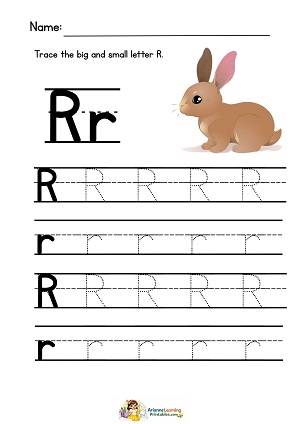
The letter R tracing worksheet is widely considered one of the most comprehensive practice tools for early childhood development. It is a unique character that acts as a “final exam” for many of the skills children have learned previously. Because the letter R combines several writing skills into one letter, it serves as an excellent benchmark for a child’s progress in fine motor control and spatial reasoning.
After practicing simpler loop letters like letter-p-tracing-worksheet-uppercase-and-lowercase-p, children are ready for the added complexity of R.
Why the Letter R is the Perfect Handwriting Exercise
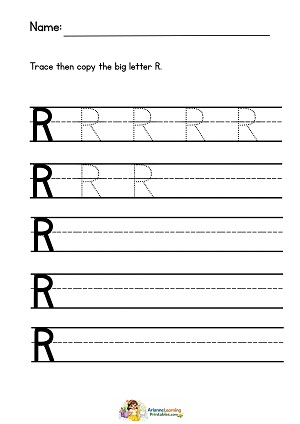
Most letters focus on a single type of movement, but the uppercase “R” is a sophisticated architectural build. It requires the writer to navigate three distinct geometric paths in a specific sequence, making it a powerhouse for hand-eye coordination.
- The Foundation (Straight Line): Every “R” begins with a strong, vertical “pillar.” This reinforces the fundamental top-to-bottom stroke order that is the basis of all English penmanship.
- The Curve (The Semicircle): Once the vertical line is established, children must add a curve to create the top loop. This requires the same “loop control” found in the letter P, helping children practice rounding a corner and connecting it back to the center of the vertical spine.
- The Finish (The Diagonal Leg): Perhaps the most challenging part is the final step. Children must finish with a diagonal leg that kicks out from the middle. This introduces the concept of slanted lines and teaches the child how to maintain balance so the letter doesn’t tip over.
Advanced Motor Planning for Preschoolers
Tracing the letter R is a masterclass in motor planning. The child cannot simply “draw” the letter; they must think several steps ahead to ensure the loop doesn’t take up too much space and that the leg has enough room to reach the baseline.
Instructional Tip: Try calling the letter R a “P with a walking stick.” This helps children who have already mastered the letter P understand that they are simply adding one more piece to a familiar shape. This “scaffolding” technique builds confidence and reduces the frustration often associated with advanced handwriting exercises.
Key Developmental Milestones in Letter R Practice
| Skill Feature | Developmental Benefit |
| Multi-Stroke Sequencing | Teaches children to follow a complex 3-step process in the correct order. |
| Point of Intersection | Helps children practice joining a diagonal line to a curved one at a specific midpoint. |
| Pencil Pressure Control | Encourages steady pressure throughout three very different types of strokes. |
Building a Foundation for Future Literacy
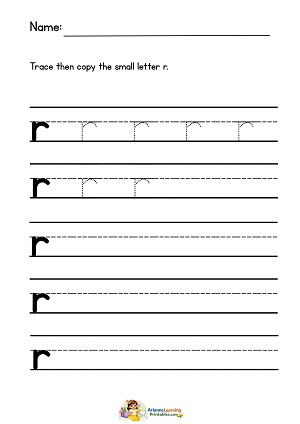
Using a dedicated letter R tracing guide allows children to break down this complex character into manageable parts. By practicing the vertical, the loop, and the diagonal leg repeatedly, they build the muscle memory required for more difficult characters like “K,” “B,” and “S.”
When a student masters the letter R, they aren’t just learning a letter of the alphabet; they are demonstrating that they can handle complex direction changes and multi-part shapes. It is a significant achievement that paves the way for fluent, legible writing in kindergarten and beyond.
Do your students find it more difficult to connect the loop back to the vertical line, or is the “kick” of the diagonal leg usually the part where they need the most practice?
🎯 Focus Skills
- Multi-step writing
- Curve control
- Diagonal strokes
✍️ Teaching Steps
- Draw the vertical line
- Add the top curve
- Finish with the diagonal leg
🎮 Activity: “Build the Letter”
Teach the letter one part at a time before combining all strokes.
⚠️ Common Mistakes
- Uneven diagonal leg
- Curve too large
- Incorrect stroke order
📊 Difficulty: Hard
🔗 Continue Learning

Will Gab is the creator of Arianne Learning Printables. He started designing worksheets to support his daughter’s kindergarten learning journey. What began as a personal project has grown into a free educational resource for parents, teachers, and children around the world.
Will Gab continues to develop printable activities based on the skills young children need as they prepare for kindergarten and early elementary school.
Related Worksheets:
 How to Teach Letter A Tracing (Free Printable Worksheet for Preschoolers)
 How to Teach Letter B Tracing (Free Printable Worksheet for Preschoolers)
 How to Teach Letter E Tracing (Free Printable Worksheet for Preschoolers)
 How to Teach Letter F Tracing (Free Printable Worksheet for Preschoolers)
 How to Teach Letter P Tracing (Free Printable Worksheet for Preschoolers)
 How to Teach Letter Q Tracing (Free Printable Worksheet for Preschoolers)
Pingback: How to Teach Letter T Tracing (Free Printable Worksheet for Preschoolers) - Arianne Learning Printables Letter T Tracing Worksheet (Free Printable + Preschool Guide)
Pingback: Alphabet Letter Tracing Worksheets A–Z - Arianne Learning Printables Alphabet Letter Tracing Worksheets A-Z | Free Printable Alphabet Practice