
The letter Q tracing worksheet offers a unique and engaging experience for early learners. While many letters are composed of either straight lines or simple curves, the letter Q is a fun challenge for preschoolers because it combines a smooth circular shape with a small tail extension. This dual-action motion makes it one of the most effective characters for developing advanced fine motor skills and spatial reasoning in young children.
After learning circular letters like letter-o-tracing-worksheet-uppercase-and-lowercase-o, children are ready to add extra details with Q.
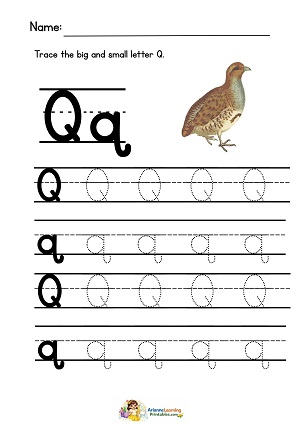
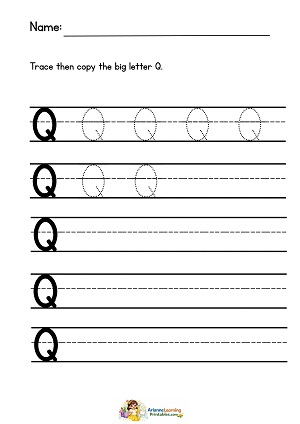
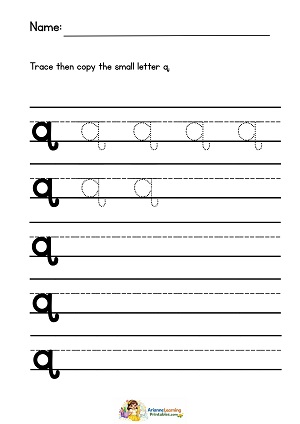
The Mechanics of the Letter Q: From Circles to “Flicks”
The uppercase “Q” is essentially a two-part mechanical exercise. It takes the foundational “O” shape and adds a secondary, distinct movement that requires a high level of pencil control.
- Practicing Continuous Motion: The first step in forming a “Q” is the large, rounded oval. This encourages children to practice continuous motion, building the wrist flexibility and hand endurance needed to draw a smooth, closed loop without lifting the pencil or creating “flat” edges.
- The Art of the Precise Finishing Stroke: The small diagonal “tail” is where the real learning happens. This “extra” step teaches children about precise finishing strokes. They must learn to wait until the primary circle is complete before adding the tail, which reinforces patience and attention to detail.
- Spatial Targeting: To make a “Q” look correct, the tail must be placed at a specific angle and location (usually the bottom right). This helps children develop visual-spatial awareness, as they have to “target” a small area of a shape they just created.
Why the Letter Q is a “Brain-Booster” for Early Writers
Tracing the letter Q is a fantastic cognitive exercise. It requires the child to plan two very different types of movements: a sweeping, large-scale curve followed by a short, sharp diagonal. This transition helps the brain practice “switching” between different motor tasks, a skill that is vital for school readiness.
Pro-Tip for Teachers: Encourage children to think of the letter Q as a “cat with a tail” or a “magnifying glass.” By giving the finishing stroke a name, you help the child remember that the letter isn’t finished until that small tail extension is added.
Key Developmental Benefits of Letter Q Worksheets
| Skill Feature | Educational Impact |
| Closed-Loop Mastery | Ensures the child can connect the beginning and end of a curve perfectly. |
| Angular Accuracy | Teaches the child to draw a short diagonal line at a consistent 45-degree angle. |
| Hand-Eye Coordination | Requires the child to look back at their work to find the correct spot for the tail. |
Building a Foundation for Complex Letters
Using a high-quality letter Q tracing guide ensures that children don’t just see the letter as a “broken circle.” By providing a structured path to follow, these worksheets help students internalize the relationship between the main body of a letter and its smaller, defining features.
Once a child masters the precise finishing strokes of the letter Q, they are better prepared for other complex characters like “G,” “R,” and even the lowercase “q” or “p.” It’s a small tail, but it leads to a big increase in handwriting confidence!
Do you find that your students enjoy the “finishing touch” of the Q’s tail, or do they sometimes forget it after they’ve finished the big circle?
🎯 Focus Skills
- Circular motion
- Tail extension control
- Pencil precision
✍️ Teaching Steps
- Draw a smooth circle
- Close the circle carefully
- Add the small tail stroke
🎮 Activity: “Add the Tail”
Draw circles and let your child add tails to transform O into Q.
👉 This helps children understand the difference between the two letters.
⚠️ Common Mistakes
- Tail too long
- Open circles
- Tail placed incorrectly
📊 Difficulty: Hard
🔗 Continue Learning
Q and U Word Practice
Most English words use q together with u. After tracing, point to qu in queen, quilt, quiet, and question. Ask the child to circle Q or q before saying each word aloud. This connects handwriting to real reading.
How to Form Q
- Uppercase Q: Make one smooth circle, then add a short diagonal tail at the lower right.
- Lowercase q: Make a small circle, then draw a straight line below the writing line.
Compare lowercase q with p and g. Say “circle first, then a line down” as the child traces. A child is ready to continue when they can name Q, say its common sound, form both versions, and find Q in a mixed row. Next, try the Letter R tracing lesson or explore the alphabet worksheet collection.

Will Gab is the creator of Arianne Learning Printables. He started designing worksheets to support his daughter’s kindergarten learning journey. What began as a personal project has grown into a free educational resource for parents, teachers, and children around the world.
Will Gab continues to develop printable activities based on the skills young children need as they prepare for kindergarten and early elementary school.
Related Worksheets:
 How to Teach Letter A Tracing (Free Printable Worksheet for Preschoolers)
 How to Teach Letter E Tracing (Free Printable Worksheet for Preschoolers)
 How to Teach Letter F Tracing (Free Printable Worksheet for Preschoolers)
 How to Teach Letter P Tracing (Free Printable Worksheet for Preschoolers)
 How to Teach Letter R Tracing (Free Printable Worksheet for Preschoolers)
 How to Teach Letter Recognition: A Complete Guide for Parents and Teachers