
The letter N tracing worksheet is a pivotal tool in early childhood education, serving as a gateway to more sophisticated penmanship. While it may appear similar to other linear letters, the letter N teaches children how to connect vertical and diagonal strokes smoothly, a skill that represents a major leap in a child’s cognitive and physical development. By focusing on the unique architecture of the “N,” young learners move beyond basic blocks and begin to master the fluid transitions required for high-level literacy.
After learning zigzag letters like letter m tracing worksheet uppercase and lowercase m, children often find N easier to understand.
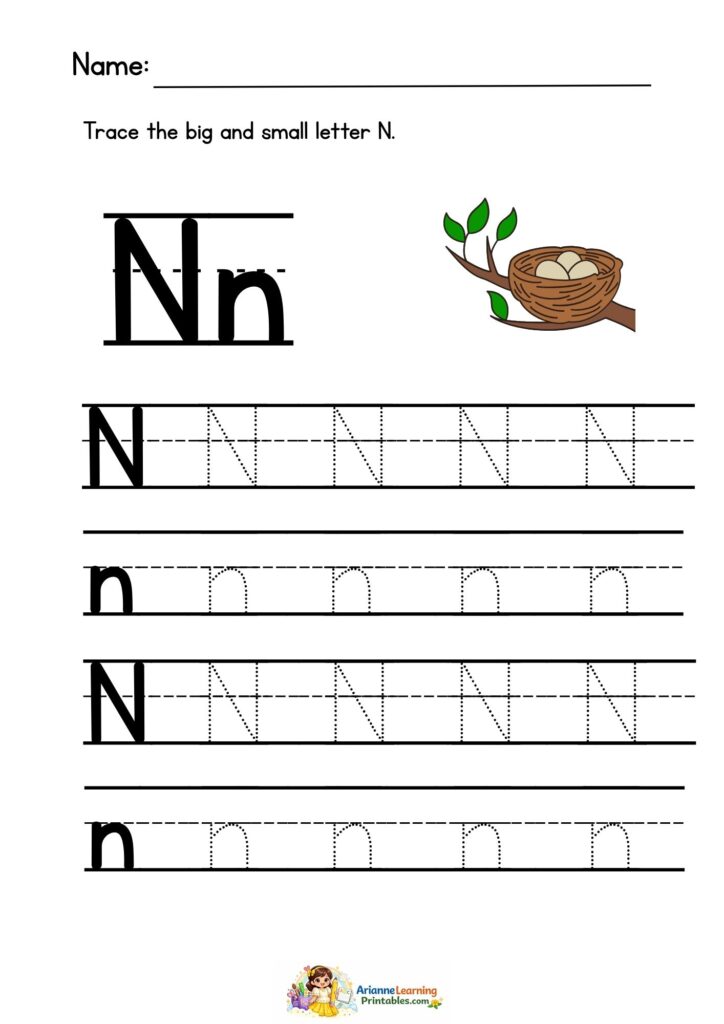
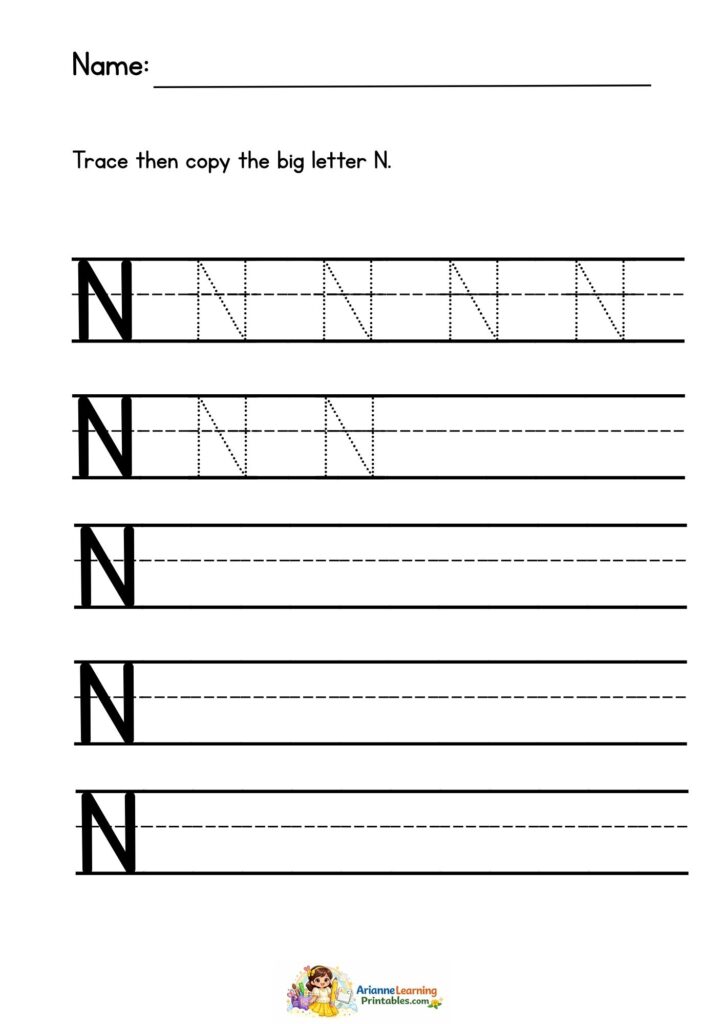
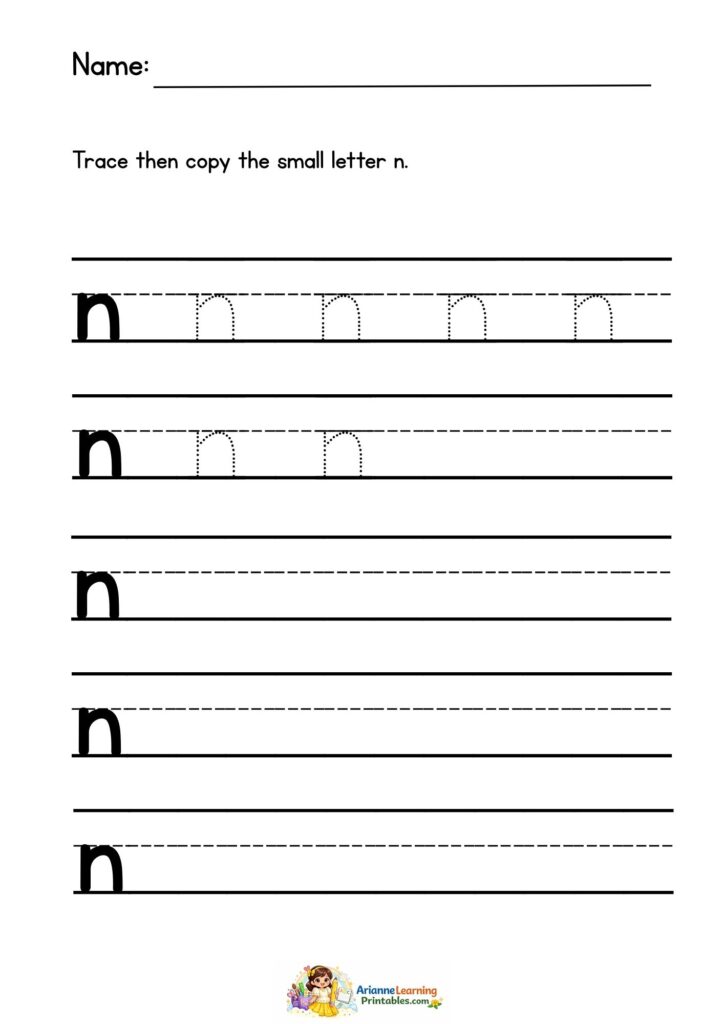
The Structural Complexity of the Letter N
In the hierarchy of handwriting, the letter N is a “structural hybrid.” It combines the stability of vertical pillars with the dynamic energy of a diagonal “slide.” This combination is why it is so effective at building advanced fine motor skills:
- Connecting Different Stroke Types: Most beginner letters use only one type of line (all straight or all curved). The letter N, however, requires the child to pivot from a vertical “plummet” into a slanted “descent.” This helps improve coordination by forcing the brain to switch motor plans mid-character.
- Mastering the Diagonal Bridge: The diagonal line in the “N” acts as a bridge between two vertical uprights. Learning to aim this diagonal so it hits the exact bottom of the second line is a fantastic exercise in spatial orientation and eye-hand coordination.
- Pencil Fluidity and Momentum: To create a clean, sharp “N,” a child must maintain momentum. This teaches them how to keep the pencil moving with intent, which is a core component of developing a natural writing rhythm.
Why the Letter N is “Pre-Cursive” Training
The movements practiced during a letter N tracing activity are the building blocks for more complex writing later in life. Because the “N” requires a “down-up-down” or “down-slide-up” motion, it prepares children for more advanced handwriting patterns, such as the “m,” “v,” “w,” and eventually, the flowing connections found in cursive script.
Parent & Teacher Tip: When working with a letter N worksheet, encourage the child to visualize a “lightning bolt” or a “mountain slide.” This helps them understand that the diagonal line shouldn’t be a separate piece, but a smooth connection that joins the two vertical lines together.
Developmental Milestones Found in Letter N Practice
| Skill Feature | Why It Matters for Growth |
| Angular Precision | Teaches the hand to create sharp points rather than rounded “loops.” |
| Consistent Slanting | Helps children understand how to maintain a specific angle across the page. |
| Stroke Integration | Builds the ability to plan a multi-directional path without losing focus. |
Enhancing School Readiness through Tracing
Using a high-quality printable letter N guide allows children to repeat these complex movements in a low-pressure environment. By following guided arrows and dashed lines, they internalize the “flow” of the letter, which reduces the “pencil fatigue” that often occurs when children struggle with direction changes.
By mastering the intersection of the vertical and the diagonal, your student isn’t just learning the 14th letter of the alphabet—they are mastering the mechanical coordination necessary for a lifetime of clear, legible communication.
Do your students find it easier to draw the “N” as one continuous zigzag, or do they prefer to draw the two vertical lines first and then “bridge” them with the diagonal?
🎯 Focus Skills
- Diagonal connections
- Direction changes
- Stroke coordination
✍️ Teaching Steps
- Draw a vertical line
- Connect with a diagonal stroke
- Finish with another vertical line
🎮 Activity: “Connect the Path”
Draw dots and let your child connect them diagonally.
⚠️ Common Mistakes
- Crooked diagonal line
- Uneven spacing
- Incorrect starting point
📊 Difficulty: Medium
🔗 Continue Learning

Will Gab is the creator of Arianne Learning Printables. He started designing worksheets to support his daughter’s kindergarten learning journey. What began as a personal project has grown into a free educational resource for parents, teachers, and children around the world.
Will Gab continues to develop printable activities based on the skills young children need as they prepare for kindergarten and early elementary school.
Related Worksheets:
 How to Teach Letter A Tracing (Free Printable Worksheet for Preschoolers)
 How to Teach Letter E Tracing (Free Printable Worksheet for Preschoolers)
 How to Teach Letter F Tracing (Free Printable Worksheet for Preschoolers)
 How to Teach Letter Q Tracing (Free Printable Worksheet for Preschoolers)
 How to Teach Letter R Tracing (Free Printable Worksheet for Preschoolers)
 How to Teach Letter Recognition: A Complete Guide for Parents and Teachers
Pingback: Alphabet Letter Tracing Worksheets A–Z - Arianne Learning Printables Alphabet Letter Tracing Worksheets A-Z | Free Printable Alphabet Practice