
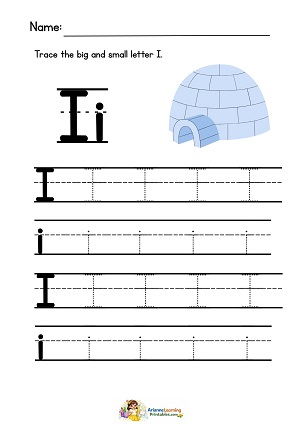
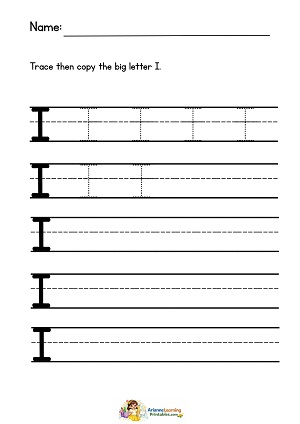
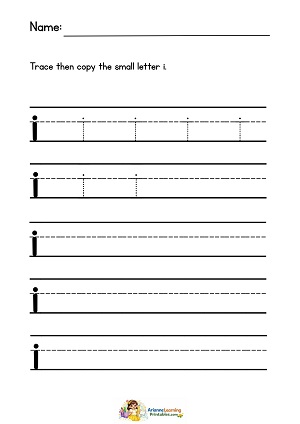
The letter I tracing worksheet is often the first “victory” a child experiences when learning to write. Because of its minimalist structure, it serves as the ultimate introductory tool for toddlers, preschoolers, and kindergarteners who are picking up a pencil for the very first time. While it may seem basic, the letter I is one of the simplest letters to learn, acting as a vital stepping stone toward more complex alphabetical characters.
After practicing structured letters like letter h tracing worksheet uppercase lowercase h, Letter I allows children to refine their control.
Why the Letter I is the Gold Standard for Beginners
When a child is just starting to develop pencil control, complex curves and multi-stroke letters can be overwhelming. The letter I strips away the frustration and focuses on the most fundamental movement in English penmanship: the vertical stroke.
- Building Foundational Pencil Control: The primary challenge for a beginner is maintaining a steady hand. The straight vertical line of the “I” allows children to practice applying consistent pressure to the paper without the distraction of changing directions or navigating corners.
- Focus on Accuracy and Consistency: Because there are no bells and whistles, the letter I helps children focus on accuracy. They learn to start exactly at the top headline and stop exactly at the bottom baseline. This develops “visual braking,” the ability to stop the pencil precisely where intended.
- Developing Vertical Alignment: Learning to draw a line that is perfectly upright (rather than slanted) is a skill that will carry over to almost every other letter in the alphabet, from “B” to “Z.”
The Psychology of Success in Early Writing
Success breeds motivation. Because the letter I is so accessible, children can master it quickly. This immediate sense of accomplishment is crucial for building a positive association with writing.
Teacher’s Tip: Use the letter I to teach the “Top-to-Bottom” rule. Always encourage the child to start their stroke at the “ceiling” and pull down to the “floor.” Establishing this habit with the easiest letter ensures they won’t struggle with “bottom-up” writing later on.
Key Benefits of Letter I Tracing Worksheets
| Skill Area | Developmental Impact |
| Fine Motor Strength | Stabilizes the “tripod grip” through repetitive, short vertical bursts. |
| Spatial Awareness | Teaches the child to recognize the boundaries of the writing line. |
| Stroke Uniformity | Helps the child produce multiple letters that look identical, a key step in legibility. |
From the Letter I to the Rest of the Alphabet
Once a student has mastered the consistency of the letter I, they have already learned the “spine” of many other characters. The vertical line they master here will eventually become part of the letters L, T, F, H, and P.
By starting with high-quality letter I tracing guides, you are giving your child the best possible introduction to literacy. It is the simplest letter, yes, but it is also the most important foundation for a lifetime of clear and confident handwriting.
Are you finding that your students prefer starting with the plain vertical line of the lowercase “i” or the capped version of the uppercase “I”?
🎯 What Makes Letter I Important?
- Simple vertical stroke
- Focus on straight-line accuracy
- Builds confidence for beginners
✍️ Teaching Steps
- Start at the top
- Draw a straight line down
- Keep the line steady
🎮 Activity: “Fast vs Slow Tracing”
Let your child:
- Trace slowly first
- Then try slightly faster
👉 Helps control speed and accuracy
⚠️ Common Mistakes
- Slanted lines
- Uneven pressure
- Wavy strokes
📊 Difficulty: Easy
🔗 Continue Learning

Will Gab is the creator of Arianne Learning Printables. He started designing worksheets to support his daughter’s kindergarten learning journey. What began as a personal project has grown into a free educational resource for parents, teachers, and children around the world.
Will Gab continues to develop printable activities based on the skills young children need as they prepare for kindergarten and early elementary school.
Related Worksheets:
 How to Teach Letter A Tracing (Free Printable Worksheet for Preschoolers)
 How to Teach Letter E Tracing (Free Printable Worksheet for Preschoolers)
 How to Teach Letter F Tracing (Free Printable Worksheet for Preschoolers)
 How to Teach Letter Q Tracing (Free Printable Worksheet for Preschoolers)
 How to Teach Letter R Tracing (Free Printable Worksheet for Preschoolers)
 How to Teach Letter Recognition: A Complete Guide for Parents and Teachers
Pingback: How to Teach Letter H Tracing (Free Printable Worksheet for Preschoolers) - Arianne Learning Printables Letter H Tracing Worksheet for Preschool (Free Printable + Guide)
Pingback: Master Phonics with Free CVC i Words Worksheets - Arianne Learning Printables Free CVC i Words Worksheets | Short i Phonics Printables