Recognizing beginning sounds helps children understand that spoken words are made from smaller sounds. When a child hears that apple begins with /a/ or sun begins with /s/, they are building the listening skills needed for decoding and spelling.
Begin with speech, pictures, and familiar objects. Letters become more meaningful after the child can hear the sound at the start of a word.
What Is a Beginning Sound?
The beginning sound is the first sound we hear in a spoken word. In map, the first sound is /m/. In fish, it is /f/. Say the sound briefly instead of adding “uh”: /m/, not “muh.”
Some words begin with more than one consonant sound, such as stop. Save blends for later and begin with clear examples such as moon, sun, cat, fish, and ball.
Use the Stretch-and-Listen Routine
Choose one object, name it normally, then stretch only its first sound: “ssssun.” Ask, “What sound did you hear first?” Have the child repeat the word and sound.
Use this three-step routine:
- Name the picture or object together.
- Stretch the beginning sound.
- Match the sound to its letter.
Work with only two or three sounds in one lesson. A short successful session is better than a large mixed set.
Sort Real Objects
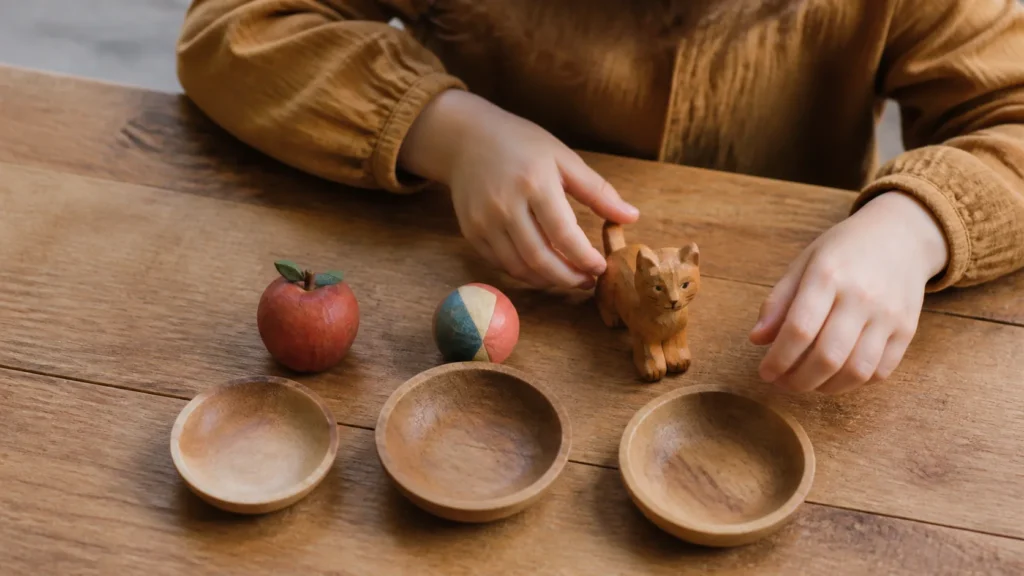
Place a few familiar objects on the table. Make one group for /b/ objects, such as ball and button, and another for /m/ objects, such as mug and marker. Say every object aloud before sorting it.
If a child chooses incorrectly, repeat both words slowly. Avoid giving the answer immediately; let the child listen again.
Download the Free Beginning Sounds Worksheet
Easy Beginning-Sound Games
Sound Hunt
Choose a sound and look around the room for objects that begin with it. Say each word and check the first sound together.
Which One Does Not Belong?
Say three words: sun, sock, map. Ask which word begins differently. Use pictures or objects if remembering all three words is difficult.
My Name Begins With
Use family names. Emphasize the first sound and find another word that starts the same way.
Common Difficulties
Children sometimes say the letter name instead of its sound. Accept the attempt, then model the sound clearly. Others may focus on the first letter they see rather than listening; cover written words during oral practice.
If sounds are hard to isolate, begin with long, stretchable sounds such as /m/, /s/, and /f/ before short stop sounds such as /b/ and /t/.
Frequently Asked Questions
Should uppercase or lowercase letters be used?
Lowercase letters appear more often in books, but children should gradually recognize both forms. The listening skill comes first.
How many sounds should we practise at once?
Two or three contrasting sounds are enough for a short lesson.
Is this the same as phonics?
Hearing the sound is phonemic awareness. Connecting that sound to a written letter is phonics. Both work together.
Final Thoughts
Beginning-sound practice should feel like careful listening, not a memory test. Name familiar objects, stretch the first sound, and connect it to a letter only when the child can hear it. Repeat the worksheet button here before the author box.

Will Gab is the creator of Arianne Learning Printables. He started designing worksheets to support his daughter’s kindergarten learning journey. What began as a personal project has grown into a free educational resource for parents, teachers, and children around the world.
Will Gab continues to develop printable activities based on the skills young children need as they prepare for kindergarten and early elementary school.
Related Worksheets:
 Master Phonics with Free CVC Short E Words Worksheets
 Sight Word “Him” Worksheet – Read, Trace, Write, and Color Printable Activity
 Sight Word “His” Worksheet – Read, Trace, Write, and Color Printable Activity
 Sight Word “with” Worksheet – Read, Write, Trace and Color Activity.
 Number Bonds to 10 Worksheets for Kindergarten (Free Printable Finger Math Activities)
 Make Ten Strategy for Kindergarten: A Simple Finger Math Guide