
A missing-addend question asks children to find an unknown part, such as 7 + __ = 10. The blank can feel unfamiliar, but the thinking is concrete: “I have seven. How many more do I need to make ten?”
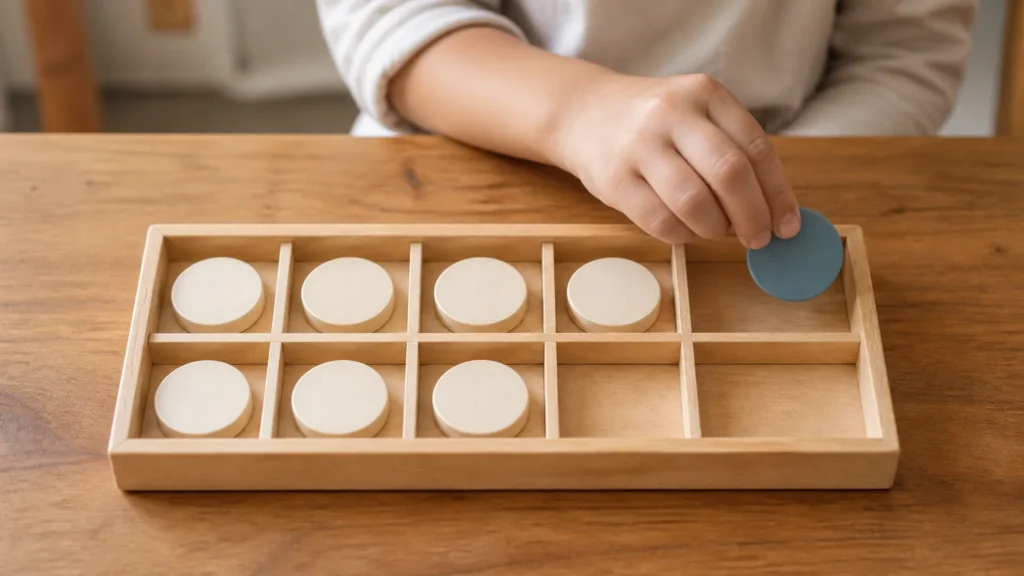
Before using written equations, let children solve the problem with fingers, counters, or a ten-frame. The symbols will make more sense after the quantity does.
What Is a Missing Addend?
In 6 + 3 = 9, the addends are 6 and 3. If one part is hidden, the equation becomes 6 + __ = 9. The child finds the missing addend by building up from 6 until the group contains 9.
Keep the missing number in different positions only after the child understands the basic format. Begin with the blank after the plus sign.
Teach It With Fingers
Say, “Show five fingers. How many more fingers make eight?” Let the child raise one finger at a time while counting on: six, seven, eight. Three more fingers were needed.
Repeat with small totals. Encourage the child to say a complete sentence: “Five and three make eight.” This connects the missing-addend question to familiar number bonds.
Teach It With a Ten-Frame
Place seven counters in a ten-frame. Ask the child to point to the empty spaces. Fill each empty space while counting, “Eight, nine, ten.” Three counters were added, so 7 + 3 = 10.
Try another target number by covering unused spaces. To solve 4 + __ = 7, show only seven available spaces, fill four, and count the empty spaces that remain.
A Simple Three-Step Routine
Use the same language for every problem:
- Build the first part. Show the number before the plus sign.
- Count on to the total. Add one object at a time.
- Count what you added. That amount is the missing addend.
This routine gives children a dependable way to begin instead of guessing.
Download the Free Missing Addends Worksheet
Hands-On Practice Ideas
Fill the Egg Carton
Use ten sections of an egg carton. Put in a few counters and ask how many more are needed to reach a chosen total.
Build the Block Tower
Show a tower of four blocks and set a goal of seven. Ask the child to add blocks until the tower reaches the goal, then count how many were added.
Hide and Reveal
Place eight counters on the table and cover some with a small cup. The visible counters are the first part; the child works out the hidden part.
When a Child Gets Stuck
Return to objects instead of repeating the equation. Ask the child to build the first number and the total. Avoid saying, “You should know this.” Missing-addend thinking is harder than ordinary addition because the unknown appears inside the equation.
Check whether the child understands the equals sign as “the same amount as.” It does not simply mean “write the answer next.” Both sides of the equation must represent equal quantities.
Frequently Asked Questions
Is a missing addend the same as subtraction?
The ideas are closely connected. A child can solve 7 + __ = 10 by counting on, or later by thinking 10 – 7 = 3.
Should kindergarten children use number lines?
Yes, after hands-on practice. Start at the known addend, jump forward to the total, and count the jumps.
How long should practice last?
Five to ten focused minutes is usually enough. Stop while the child is still successful.
Final Thoughts
Missing addends become easier when the blank represents a real group the child can build. Use concrete objects, repeat the three-step routine, and finish with a few worksheet questions. Confidence grows through small successes.

Will Gab is the creator of Arianne Learning Printables. He started designing worksheets to support his daughter’s kindergarten learning journey. What began as a personal project has grown into a free educational resource for parents, teachers, and children around the world.
Will Gab continues to develop printable activities based on the skills young children need as they prepare for kindergarten and early elementary school.
Related Worksheets:
 Best Worksheets for Preschool: A Complete Guide for Parents and Teachers
 How to Teach Counting to Preschoolers: Fun and Easy Learning Guide
 Benefits of Tracing Worksheets for Preschool
 Alphabet Letter Tracing Worksheets A–Z
 How to Prepare My Child to Be Good at Math: 15 Simple Secrets Every Parent Should Know
 How to Use Printable Worksheets Without Overwhelming Your Kindergartener