
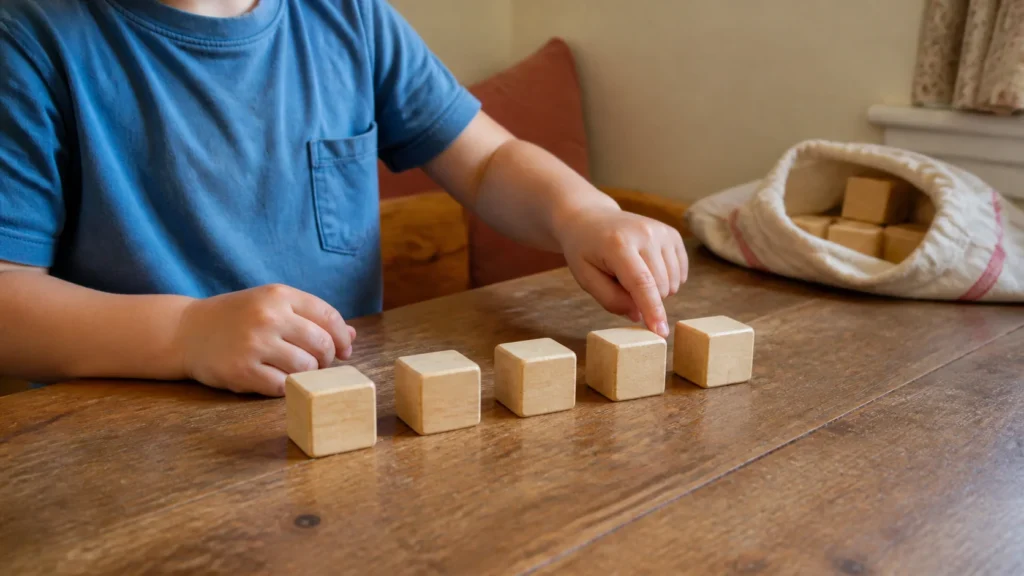
Many children learn to say “one, two, three” before they understand what each number means. Real counting begins when a child matches one number word to one object and understands that the last number tells how many objects are in the group.
You can build this number sense without special toys. Socks, blocks, spoons, steps, toy animals, and snacks can all become simple counting games for preschoolers.
Keep the groups small at first. Accuracy and understanding matter more than counting to a very high number.
What Preschoolers Learn From Counting Games
Hands-on counting helps children practice:
- saying number words in order;
- touching one object for each number word;
- understanding that the final number represents the total;
- recognizing small quantities;
- comparing more and fewer;
- connecting written numerals to real groups; and
- noticing how a quantity changes when an object is added or removed.
These are useful foundations for the site’s numbers and math worksheets.
Before You Begin: Three Helpful Counting Habits
Move each object
Ask your child to slide each object into a new group while counting. Moving objects makes it easier to see which ones have already been counted.
Say one number for one object
Model a steady pace. If the fingers move faster than the number words, slow down and begin again with a smaller set.
Ask “How many?”
After counting, ask how many objects there are. If the child immediately repeats the final number, they are beginning to understand the total.
1. Set the Table
Ask your child to place one spoon for each family member. Count the people, then count the spoons.
Try questions such as:
- Do we have enough?
- How many more do we need?
- Are there more spoons or plates?
Use safe, unbreakable tableware while your child is learning.
2. Sock Match and Count
Place several clean socks in a basket. Match them into pairs, then count the pairs and individual socks.
Ask what happens when one sock is removed. This everyday task introduces matching, grouping, and the idea that two items can make a pair.
3. Toy Animal Line-Up
Invite your child to place toy animals in a row. Touch each animal while counting.
Give simple directions:
- Put three animals near the block.
- Add one more animal.
- Which group has fewer?
Change the animals or story to keep the game interesting without changing the math skill.
4. Count the Steps
Count aloud while walking up a short, safe flight of steps with close supervision. Say one number for each step.
You can also count jumps, claps, or slow marching steps on a flat floor. Movement helps children hear and feel a steady counting rhythm.
5. Build a Block Tower
Choose a number from one to ten and build a tower with that many blocks. Count again as you take the tower apart.
Compare two towers:
- Which is taller?
- Which used more blocks?
- How many blocks would make them equal?
6. Snack Count
Place a small number of appropriate snack pieces on a plate. Ask the child to count them before eating.
Say, “You have five pieces. If you eat one, how many are left?” Follow all dietary and choking-safety guidance appropriate for your child.
7. Number Parking Lot
Write numerals 1 through 5 on separate pieces of paper and place them on the floor. Choose a numeral, name it together, and park that many toy cars beside it.
When your child is confident, mix up the numeral cards instead of keeping them in order.
8. Egg Carton Fill-Up
Use a clean cardboard egg carton as a counting tray. Ask the child to place one safe object in each section.
Count as the sections fill. Stop at a chosen number or compare a full row with a partly filled row. Avoid small objects if they are not safe for your child.
This activity also practices the hand control described in our article about fine motor activities for preschoolers.
9. Find-and-Count Hunt
Choose a safe object and search one room for examples. You might count doors, pillows, chairs, books, or blue items.
Bring movable objects into one place when possible so the child can count them accurately. For fixed objects, point carefully to each one.
10. Drop and Count
Give your child a cup and several large blocks or other safe objects. Drop them into the cup one at a time while counting each sound.
Pour the objects out and count again. Ask whether the total stayed the same even though the objects moved.
11. Roll and Do
Roll a standard dot die and count the dots. Do that many actions: clap, stomp, jump, tap the table, or place blocks in a row.
At first, let the child touch each dot. With practice, they may recognize small dot patterns without counting every dot.
12. Mystery Bag Counting
Place one to five safe objects in an opaque bag. Let the child remove one object at a time and line them up.
Before counting, ask for an estimate: “Do you think there are two, five, or ten?” Then count to check. Estimating is about making a reasonable guess, not being correct every time.
A Five-Day Counting Practice Plan
Repeat skills in different settings instead of introducing a completely new concept every day.
| Day | Activity | Main skill |
|---|---|---|
| Monday | Set the table | One object for each person |
| Tuesday | Block towers | Counting and comparing |
| Wednesday | Number parking lot | Matching numeral to quantity |
| Thursday | Count the steps | Number order and movement |
| Friday | Mystery bag | Estimating and checking |
Each activity can take five to ten minutes. Stop while your child is still interested.
What to Do When a Child Miscounts
Miscounting shows you which part of the process needs practice.
The child skips objects
Arrange the objects in a straight line or ask the child to move each one into a container.
The child counts one object twice
Increase the space between objects or move each counted object to a clearly separate group.
The child skips a number word
Practice the spoken sequence through songs and movement, then return to a small group of objects.
The child gives a different answer to “How many?”
Count again and emphasize the last number: “One, two, three, four. There are four.”
The child becomes frustrated
Use fewer objects and return to a favorite game. A successful group of three can teach more than a stressful group of twenty.
Move From Objects to Worksheets
Children often understand a printed math problem more easily after working with real quantities.
Try this sequence:
- Count actual objects.
- Count pictures of objects.
- Match the group to a written numeral.
- Trace or write the numeral.
- Add or remove one object and recount.
When your child is ready, use the number tracing worksheets and counting and matching numbers 1–5 worksheets for paper-based practice.
Frequently Asked Questions
How high should a preschooler count?
Children develop at different rates, and expectations vary. Focus first on accurately counting small groups and understanding quantity rather than memorizing the longest possible sequence.
My child can count to 20 but cannot count objects. Is that normal?
Reciting numbers and counting objects are related but different skills. Practice moving one object for each number word with groups of three to five.
Should children use their fingers to count?
Fingers are a useful, always-available visual model. They help children represent small quantities and can support early addition and subtraction.
How often should we practice counting?
Brief daily opportunities are enough: count plates, toys, steps, or fruit while completing normal routines. Formal lessons are not necessary every time.
When should we begin addition?
Begin informally when your child can count small groups accurately. Add one object and ask how many there are now. Keep the objects visible before expecting mental answers.
Final Thought
Counting becomes meaningful when numbers describe something a child can see and touch. Use familiar objects, begin with small groups, and let your child move each item.
Once your child understands that numbers represent real quantities, number tracing, matching, addition, and subtraction have a much stronger foundation.

Will Gab is the creator of Arianne Learning Printables. He started designing worksheets to support his daughter’s kindergarten learning journey. What began as a personal project has grown into a free educational resource for parents, teachers, and children around the world.
Will Gab continues to develop printable activities based on the skills young children need as they prepare for kindergarten and early elementary school.
Related Worksheets:
 Best Worksheets for Preschool: A Complete Guide for Parents and Teachers
 How to Teach Counting to Preschoolers: Fun and Easy Learning Guide
 Benefits of Tracing Worksheets for Preschool
 Alphabet Letter Tracing Worksheets A–Z
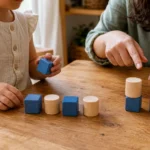 How to Prepare My Child to Be Good at Math: 15 Simple Secrets Every Parent Should Know
 Kindergarten Readiness Checklist: 25 Skills to Practice Before School