
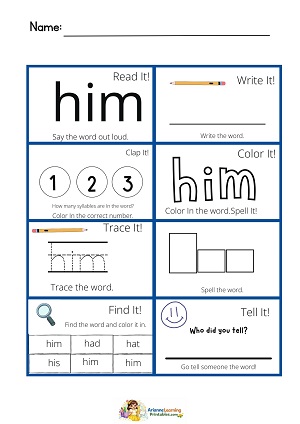
The sight word “him” appears often in early stories and conversations. This free worksheet helps kindergarten readers recognize, trace, write, and use “him” while also learning what the word means in a sentence.
Learning objective: The child will read “him” automatically, write its three letters in order, and choose “him” when a boy or man receives an action.
How to Teach “him”
Use two toy figures and act out a simple direction: “Give him the ball.” Ask the child who receives the ball. Repeat with “Sit beside him” and “Wave to him.” The movement makes the meaning clearer than memorizing the letters alone.
After the meaning is understood, read the word on the worksheet, trace it slowly, and write it from memory. Keep practice short and return to the word in books or daily conversation.
A Teaching Observation
Children often know “him” when they hear it but confuse it with “his” or “he” in print. Asking the child to act out the sentence usually reveals whether the difficulty is word recognition or sentence meaning.
Common Mistakes
- Using “he” instead of “him”: compare “He runs” with “I see him.”
- Confusing “him” and “his”: explain that “his” shows belonging, while “him” names the person receiving the action.
- Guessing from the first letter: point under h-i-m and read every letter in sequence.
Practice Sentences
- Please give him the book.
- The puppy followed him.
- We waved to him.
- I sat beside him.
- Dad read with him.
Quick Mastery Check
Say “___ is running” and “I can see ___.” The child should choose “he” for the first sentence and “him” for the second, then write “him” without copying.
Continue with our sight word “his” worksheet, browse the complete sight word collection, or try more kindergarten reading activities.

Will Gab is the creator of Arianne Learning Printables. He started designing worksheets to support his daughter’s kindergarten learning journey. What began as a personal project has grown into a free educational resource for parents, teachers, and children around the world.
Will Gab continues to develop printable activities based on the skills young children need as they prepare for kindergarten and early elementary school.
Related Worksheets:
 Sight Word “And” Worksheet – Read, Write, Trace and Color Activity
 Sight Word “The” Worksheet – Read, Write, Trace and Color
 Sight Word “His” Worksheet – Read, Trace, Write, and Color Printable Activity
 Sight Word “if” Worksheet – Read, Write, Trace and Color Activity.
 Sight Word “in” Worksheet – Read, Write, Trace and Color
 Sight Word “of” Worksheet – Read, Write, Trace and Color