
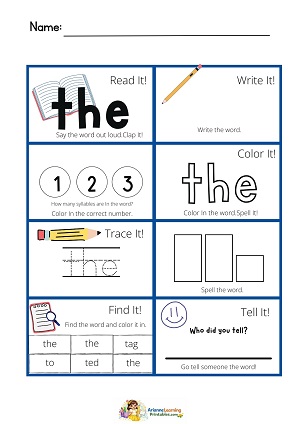
Learning sight words is an important step in early reading development. This Sight Word “the” worksheet helps preschool, kindergarten, and early elementary learners recognize, read, write, and remember this common word.
Sight words are frequently used words that children should recognize instantly without sounding them out. Words like the, you, and, is, and it appear often in books and everyday reading.
This printable worksheet allows children to practice the sight word “the” through a variety of engaging activities that build reading confidence and literacy skills.
Worksheet Activities
This sight word worksheet includes several fun learning activities:
Read It
Students read the word “the” and say it out loud to practice word recognition.
Write It
Children practice writing the word to improve handwriting and spelling.
Color It
Students color the sight word while focusing on letter recognition.
Trace It
Tracing dotted letters helps learners practice correct letter formation and develop fine motor skills.
Spell It
Children identify and spell each letter in the sight word.
Find It
Students search for the correct word among other words to strengthen recognition skills.
Tell It
Children practice using the word by sharing it with someone to reinforce learning.
Why Sight Words Are Important
Practicing sight words helps children:
• Improve reading fluency
• Recognize common words instantly
• Strengthen early literacy skills
• Build confidence in reading
• Develop stronger vocabulary
Sight word activities are especially helpful for preschool, kindergarten, and early elementary students learning to read.
Perfect For
This worksheet is great for:
• Preschool learning
• Kindergarten reading practice
• Early elementary literacy centers
• Homeschool activities
• Classroom reading practice
• Sight word intervention practice
Download the Worksheet
Download and print this Sight Word “the” worksheet to help children practice reading, writing, tracing, and recognizing this important word.
Practice the Sight Word “the” in Real Sentences
“The” points to a particular person, place, or thing that the speaker and listener can identify. It appears constantly in beginner books.
Five Child-Friendly Examples
- The dog is sleeping.
- Open the red box.
- We walked to the park.
- The moon looks bright.
- Please close the door.
Hands-On Practice Game
Set out three familiar objects and give clues such as “Touch the cup” or “Move the blue crayon.” Let the child become the teacher and give the next direction.
A Common Mix-Up to Watch For
Young readers may substitute “a” for “the.” Explain that “the” means a specific one, and practice it as a whole word instead of trying to sound it out letter by letter.
Quick Mastery Check
Point to “the” in three different sentences. Mastery is shown when the child reads it immediately each time without pausing to decode. For more early-reading practice, visit our phonics and reading collection.
Why “the” Needs Special Practice
The appears constantly in early books, but children cannot reliably sound it out one letter at a time. Explain that th works together at the beginning and that the final vowel is usually spoken softly. Let the child watch your mouth, repeat the word naturally, and avoid stretching it into separate sounds.
Read “the” in Meaningful Phrases
Practice short phrases before full sentences: the dog, the red ball, the little cat, and the big tree. Place three object pictures on the table and say, “Point to the ball.” Then let the child give you a direction using the. This demonstrates that the word introduces a particular person, place, animal, or thing.
A child is gaining mastery when they can recognize the in different fonts, read it without a picture clue, write it from memory, and use it naturally in a sentence. Keep review brief and return to it across several days. Explore more practice in the reading worksheets hub or strengthen letter knowledge in the alphabet worksheet collection.
Continue Sight Word Learning
Use the sight word worksheet collection for spaced review, then visit the reading worksheets hub for phonics, fluency, and comprehension practice.

Will Gab is the creator of Arianne Learning Printables. He started designing worksheets to support his daughter’s kindergarten learning journey. What began as a personal project has grown into a free educational resource for parents, teachers, and children around the world.
Will Gab continues to develop printable activities based on the skills young children need as they prepare for kindergarten and early elementary school.
Related Worksheets:
 Sight Word “And” Worksheet – Read, Write, Trace and Color Activity
 Sight Word “You” Worksheet – Read, Write, Trace and Color
 Sight Word “His” Worksheet – Read, Trace, Write, and Color Printable Activity
 Sight Word “if” Worksheet – Read, Write, Trace and Color Activity.
 Sight Word “in” Worksheet – Read, Write, Trace and Color
 Sight Word “of” Worksheet – Read, Write, Trace and Color