
The letter V tracing worksheet is a significant developmental tool for young writers transitioning from basic vertical lines to more complex geometric shapes. While it may appear simple with just two strokes, the letter V teaches children how to create sharp angles using diagonal strokes, a skill that is fundamental to advanced penmanship and artistic control.
After practicing curved letters like letter-u-tracing-worksheet-uppercase-and-lowercase-u, V introduces a completely different motion style.
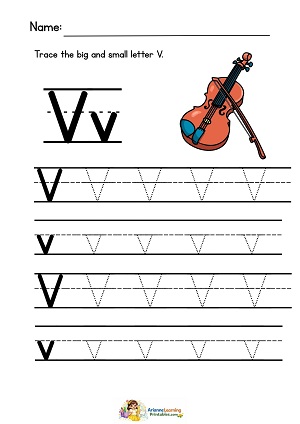
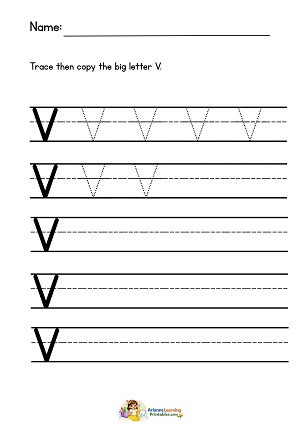
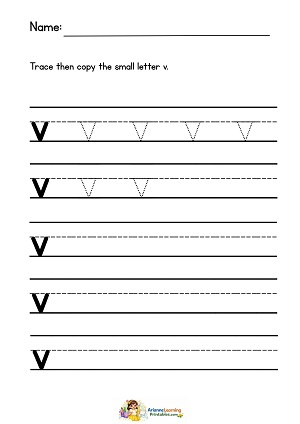
The Power of the Diagonal: Why the Letter V Matters
In early childhood education, moving from horizontal and vertical lines to diagonals represents a “level up” in visual-motor integration. The letter V is the perfect introduction to this concept because it strips away all other distractions and focuses purely on the “slant.”
- Improving Writing Precision: Unlike a rounded “U,” the letter V requires a “hard stop” at the bottom. This helps children practice precision by teaching them exactly where to halt their downward momentum before changing direction.
- Enhancing Directional Control: To form a proper V, a child must mirror the first stroke with the second. This develops spatial awareness and bilateral coordination, as they learn to maintain a consistent angle on both the “down-slide” and the “up-climb.”
- Developing the “Point”: Mastering the sharp vertex of the V is essential. It teaches children how to manage “pencil braking,” ensuring their lines meet at a crisp point rather than a sloppy, rounded curve.
A Foundation for Advanced Alphabet Mastery
The skills honed during a letter V tracing activity are not limited to just one character. The ability to control diagonal lines is a prerequisite for a significant portion of the alphabet.
Teaching Tip: Encourage your students to think of the letter V as a “valley” or a “bird’s beak.” This visualization helps them remember that the bottom must be sharp and pointed. Using the phrase “Slide down, climb up!” can help them find the directional control needed to keep the letter symmetrical.
Key Developmental Benefits of Letter V Worksheets
| Skill Feature | Educational Impact |
| Diagonal Fluency | Prepares the hand for letters like W, X, K, and Y. |
| Symmetry Practice | Encourages the child to judge distances so both “arms” of the V are equal. |
| Fine Motor Focus | Requires a deliberate change in pencil pressure at the base of the letter. |
Strengthening School Readiness Through Practice
Using a high-quality printable letter V guide allows children to build the muscle memory required for confident writing. By following the guided arrows, they learn the most efficient way to construct the letter, which prevents “drawing” the letter from the bottom up—a common habit that can slow down writing speed in later grades.
Once a child masters the sharp angles of the letter V, they gain a sense of geometric confidence. They begin to see how different angles and slants create different characters, turning the act of writing into a precise and intentional craft.
Do you find that your students tend to make their “V”s a little too wide, or is the biggest challenge getting them to stop at a sharp point at the bottom?
🎯 Focus Skills
- Sharp angle formation
- Diagonal control
- Stroke accuracy
✍️ Teaching Steps
- Draw a diagonal line downward
- Change direction upward
- Keep the bottom point sharp
🎮 Activity: “Draw Check Marks”
Practice check-mark shapes before tracing V.
⚠️ Common Mistakes
- Rounded bottom point
- Uneven diagonal lines
- Incorrect angle spacing
📊 Difficulty: Medium
🔗 Continue Learning

Will Gab is the creator of Arianne Learning Printables. He started designing worksheets to support his daughter’s kindergarten learning journey. What began as a personal project has grown into a free educational resource for parents, teachers, and children around the world.
Will Gab continues to develop printable activities based on the skills young children need as they prepare for kindergarten and early elementary school.
Related Worksheets:
 How to Teach Letter A Tracing (Free Printable Worksheet for Preschoolers)
 How to Teach Letter B Tracing (Free Printable Worksheet for Preschoolers)
 How to Teach Letter E Tracing (Free Printable Worksheet for Preschoolers)
 How to Teach Letter F Tracing (Free Printable Worksheet for Preschoolers)
 How to Teach Letter P Tracing (Free Printable Worksheet for Preschoolers)
 How to Teach Letter Q Tracing (Free Printable Worksheet for Preschoolers)
Pingback: How to Teach Letter X Tracing (Free Printable Worksheet for Preschoolers) - Arianne Learning Printables Letter X Tracing Worksheet (Free Printable + Preschool Practice)
Pingback: Alphabet Flash Card Fruit Themed Learning: Why "V is for Vanilla" is Perfect for Kids - Arianne Learning Printables Alphabet Flash Card Fruit Themed Learning: V is for Vanilla