
Building strong early reading skills starts with mastering Consonant-Vowel-Consonant (CVC) words. After mastering short a CVC words, learners can build reading skills with engaging short e CVC worksheets.
Teaching short “e” sounds can be challenging because children often confuse them with short “i” sounds. That is why targeted, visual, and engaging practice is so essential!
Arianne Learning Printables offers free short “e” worksheets helping preschoolers confidently blend, read, and write CVC words.
Why Focus on CVC Short “e” Words?
CVC words are foundational because they are phonetically regular. This means kids can easily sound them out letter-by-letter (e.g., /h/ /e/ /n/ = hen) without worrying about complex vowel teams.
Focusing on the short “e” pattern helps children:
- Improve Phonemic Awareness: Recognizing the distinct middle vowel sound in words. If your student needs a refresher on the individual letter sounds first, utilizing a dedicated letter e tracing worksheet is a great prerequisite.
- Boost Blending Skills: Smoothly connecting a starting consonant to the “-ed”, “-en”, “-et”, or “-eg” word families.
- Enhance Vocabulary: Connecting written words to everyday objects like a web, jet, or pen.
To ensure a well-rounded reading foundation, parents and teachers should pair these phonics lessons with high-frequency sight words. While sounding out words phonetically is crucial, fluency truly accelerates when kids can instantly recognize common words like the sight word “and” or the sight word “the”.
What’s Included in This Free Worksheet Packet?
This thoughtfully structured PDF contains 4 distinct pages layout to progressively challenge your child from basic word recognition to reading phrases.
1. Picture Word Association & Reading Practice
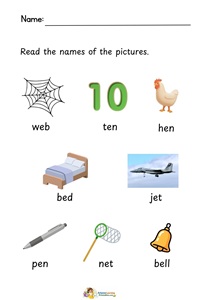
The introductory page features large, clear graphics of common short “e” objects alongside their labels. Children look at the vibrant images of a web, hen, bed, jet, and net while reading the words aloud to anchor the sound in their minds.
2. Encircle the Correct Word Challenge
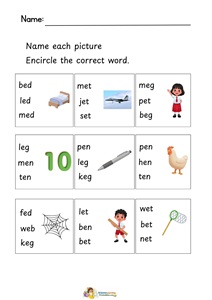
The second page tests independent recognition. Children look at a picture and choose between three similar-looking CVC words (e.g., deciding if an image is a bed, met, or meg). This exercises their attention to detail, forcing them to look closely at both the initial and ending consonants. If they struggle with spotting the differences, reinforcing their skills with general alphabet recognition worksheets can provide an extra confidence boost.
3. “Read and Match” Phrase Fluency
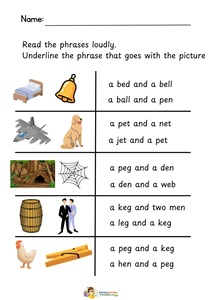
Moving past isolated words, the third page encourages sentence structure and reading fluency. Students read simple phrases out loud—such as “a bed and a bell” or “a pet and a net”—and underline the phrase that correctly matches the accompanying illustration. For students who excel at this level, you can transition them to our comprehensive CVC short e sentences fluency worksheets for extended story reading.
4. CVC Box Writing Assessment
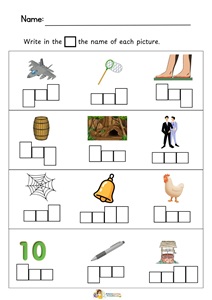
The final page transitions students from reading to writing. Using elkonin-style letter boxes, children look at images (like a barrel/keg, a cave/den, men, or a well) and physically write out the three-letter words. The boxes give a visual cue for spatial awareness, reinforcing that each box holds a single letter sound.
Tips for Parents and Teachers
To get the most out of these CVC short e words worksheets, try incorporating these interactive strategies into your lesson plan:
- Segment First, Write Second: Before your child writes a word on the writing page, have them tap out the sounds on their fingers. For ten, they tap: /t/ (index), /e/ (middle), /n/ (ring). Understanding the foundational benefits of tracing worksheets will help you guide them through the physical mechanics of early writing.
- Combine Reading with Fine Motor Skills: Keep early learning dynamic! If your child experiences fatigue during writing exercises, break up the lesson by incorporating low-pressure fine motor tasks, like tracing from alphabet letter tracing A-Z or utilizing a playful duck color by number sheet.
- Create a Short “e” Word Wall: Cut out the pictures from the first page and stick them on a wall or fridge. Ask your child to point to the correct word when you sound it out loud.
Download Your Free Phonics Worksheets Today!
Ready to supercharge your student’s reading confidence? Head over to our comprehensive guide on the best worksheets for preschool to see how to properly structure your early childhood curriculum, or directly grab this short “e” printable alongside dozens of other literacy, math, and development resources.
Click Here to Download the Free CVC Short E Worksheets Packet!

Will Gab is the creator of Arianne Learning Printables. He started designing worksheets to support his daughter’s kindergarten learning journey. What began as a personal project has grown into a free educational resource for parents, teachers, and children around the world.
Will Gab continues to develop printable activities based on the skills young children need as they prepare for kindergarten and early elementary school.
Related Worksheets:
 CVC Short A Sentences Worksheet – Read, Highlight & Color Worksheets (Free Printable)
 CVC Short E Sentences Fluency – Read, Highlight & Color Worksheets (Free Printable)
 CVC A Pattern Worksheets – Free Printable CVC Words for Beginning Readers
 Sight Word “Him” Worksheet – Read, Trace, Write, and Color Printable Activity
 Sight Word “His” Worksheet – Read, Trace, Write, and Color Printable Activity
 Sight Word “with” Worksheet – Read, Write, Trace and Color Activity.